Today's
EarthStation1.com 15% Off Commemorative Memorial Title: TV
Commercials: The Cable Age Classics II DVD, Download, USB Drive
Today, January 23, 2026
January 23: National Pie Day: -- A yummy
annual celebration of one of the Nations' favorite desserts! No
matter how you slice it, pie in just about any form makes a crowd
happy. Fruit pies, berry pies, cream pies - they are mouthwatering
servings of homemade goodness. National Pie Day simply celebrates
the pie. Everyone is invited to bake their favorite pie, but more
importantly, the day reminds us to enjoy eating pies! The only
other question to ask is, will it be al a mode? Did you know, the
first pies appeared around 9500 BC in the Egyptian Neolithic
period or New Stone Age? So, humans have been eating pies for a
very long time. And with so many to choose from, we shouldn't have
any problem finding one we like. After all, we celebrate the day
twice a year (plus their cousin National Pi Day). Cream-filled or
topped pies are favorite props for humor. Throwing a pie in a
person's face has been a staple of film comedy since Ben Turpin
received one in Mr. Flip in 1909. The day also offers a perfect
opportunity to give a shout-out to your favorite bakery. They
always serve up the best and flakiest crusts. And we know,
sometimes that bakery is known as Grandma's House. Use the holiday
to honor her by learning to bake her best recipes. Take a lesson
or two from the master! Or try a new recipe together. The American
Pie Council created National Pie Day in 1986 to commemorate
Crisco's 75th anniversary of "serving foods to families
everywhere." On Sale @ 15% Off Discount Till Midnight PT!
https://store.earthstation1.com/tv-commercials-the-cable-age-classics-ii-dvd.html
Today's
EarthStation1.com 15% Off Commemorative Memorial Title: The
History Of Jazz A Video Retrospective DVD, MP4 Download, USB Drive
Today, January 23, 2026
January 23, 1910: #BOTD: #HBD! Django
Reinhardt, Belgian-born Romani-French jazz guitarist and composer,
regarded as one of the greatest musicians of the twentieth century
(d. May 16, 1953) is #born Jean Reinhardt in Liberchies,
Pont-a-Celles, Belgium, into a Belgian family of Manouche Romani
(French Romani) descent. Jean Reinhardt, known by his stage name
Django Reinhardt, was the first jazz talent to emerge from Europe
and remains thusfar the most significant. With violinist Stephane
Grappelli, Reinhardt formed the Paris-based Quintette du Hot Club
de France in 1934. The group was among the first to play jazz that
featured the guitar as a lead instrument. Reinhardt recorded in
France with many visiting American musicians, including Coleman
Hawkins and Benny Carter, and briefly toured the United States
with Duke Ellington's orchestra in 1946. He died suddenly of a
stroke at the age of 43. Reinhardt's most popular compositions
have become standards within gypsy jazz, including "Minor
Swing", "Daphne", "Belleville",
"Djangology", "Swing '42", and "Nuages".
Jazz guitarist Frank Vignola claims that nearly every major
popular-music guitarist in the world has been influenced by
Reinhardt. Over the last few decades, annual Django festivals have
been held throughout Europe and the U.S., and a biography has been
written about his life. In February 2017, the Berlin International
Film Festival held the world premiere of the French film Django.
Django Reinhardt died suddenly of a brain hemorrhage at the age of
43 in Fontainebleau, France, collapsing outside his home at the
end of a walk from Fontainebleau-Avon trains station after playing
in a Paris club. It was a Saturday, and it took a full day for a
doctor to arrive. Reinhardt was declared dead on arrival at the
hospital in Fontainebleau. He is buried at Samois-Sur-Seine
Cemetery in Samois-sur-Seine, Seine-Et-Marne Department,
Ile-De-France, France. #DjangoReinhardt #Romani #Gypsies
#Composers #Guitarists #Jazz #JazzMasters #HotClubOfFrance
#HotClubDeFrance #QuintetOfTheHotClubOfFrance
#QuintetteDuHotClubDeFrance #StephanGrappelli #Nuages #MP4
#VideoDownload #DVD On Sale @ 15% Off Discount Till Midnight PT!
https://store.earthstation1.com/the-history-of-jazz-by-billy-taylor-parts-i-amp-ii-dvd.html
Today's
EarthStation1.com 15% Off Commemorative Memorial Title: Lost Ernie
Kovacs TV Show Collection DVD, MP4 Download, USB Drive
Today, January 23, 2026
January 23, 1919: #BOTD: #HBD! Ernie
Kovacs, American comedian, actor, writer and game show host (d.
January 13, 1962) is #born Ernest Edward Kovacs in Trenton, New
Jersey. Ernie Kovacs' visually experimental and often spontaneous
comedic style influenced numerous television comedy programs for
years after his death. Many individuals and shows, such as Johnny
Carson, David Letterman, Rowan and Martin's Laugh-In, Saturday
Night Live, Monty Python's Flying Circus, Jim Henson, Max
Headroom, Chevy Chase, Conan O'Brien, Jimmy Kimmel, Captain
Kangaroo, Sesame Street, The Electric Company, Dave Garroway,
Uncle Floyd, and many others have credited Ernie as an influence.
Chevy Chase thanked Kovacs during his acceptance speech for his
Emmy award for Saturday Night Live. Some of Kovacs' unusual
behaviors include having pet marmosets and wrestling a jaguar on
his live Philadelphia television show. When working at WABC (AM)
as a morning-drive radio announcer and doing a mid-morning
television series for NBC, Kovacs claimed to dislike eating
breakfast alone while his wife, Edie Adams, was sleeping after her
Broadway performances. His solution was to hire a taxi driver to
come into their apartment with his own key and make breakfast for
them both, then take Ernie to the WABC studios. While working in
Vermont during 1939, he became so seriously ill with pneumonia and
pleurisy that his doctors didn't expect him to survive. During the
next year and a half, his comedic talents developed as he
entertained both doctors and patients with his antics during stays
at several hospitals. While hospitalized, Kovacs developed a
lifelong love of classical music by the gift of a radio, which he
kept tuned to WQXR. While Kovacs and Adams received Emmy
nominations for best performances in a comedy series during 1957,
his talent was not recognized formally until after his death. The
1962 Emmy for Outstanding Electronic Camera Work and the
Directors' Guild award came a short time after his fatal accident.
A quarter century later, he was inducted into the Academy of
Television Arts and Sciences Hall of Fame. Kovacs also has a star
on the Hollywood Walk of Fame for his work in television. In 1986,
the Museum of Broadcasting (later to become the Museum of
Television amd Radio and now the Paley Center for Media) presented
an exhibit of Kovacs' work, called The Vision of Ernie Kovacs. The
Pulitzer Prize-winning television critic, William Henry III, wrote
for the museum's booklet: "Kovacs was more than another
wide-eyed, self-ingratiating clown. He was television's first
significant video artist.". Ernie Kovacs died in a car crash
when he lost control of his Chevrolet Corvair station wagon while
turning quickly and crashed into a power pole in Beverly Hills. He
was thrown halfway out the vehicle's passenger side and died
almost instantly from chest and head injuries. A photographer
arrived soon after and images of Kovacs' body - with an unlit
cigar on the pavement near his outstretched hand - appeared in
newspapers across the United States. In keeping Kovacs's wishes, a
simple service was held at the Beverly Hills Community
Presbyterian Church. The pallbearers included Jack Lemmon, Frank
Sinatra, Dean Martin, Billy Wilder, and Mervyn LeRoy, and George
Burns, Groucho Marx, Edward G. Robinson, Kirk Douglas, Jack Benny,
James Stewart, Charlton Heston, Buster Keaton and Milton Berle
also attended. The pastor said that Kovacs had summed up his life
thus: "I was born in Trenton, New Jersey in 1919 to a
Hungarian couple. I've been smoking cigars ever since." He is
buried in Forest Lawn-Hollywood Hills Cemetery in Los Angeles. His
epitaph reads "Nothing in moderation - We all loved him."
On Sale @ 15% Off Discount Till Midnight PT!
https://store.earthstation1.com/lost-ernie-kovacs-dual-layer-dvd-old-time-tv-shows.html
Today's
EarthStation1.com 15% Off Commemorative Memorial Title: The Great
War (1964) TV Documentary Series DVD, Video Download, USB
Today, January 23, 2026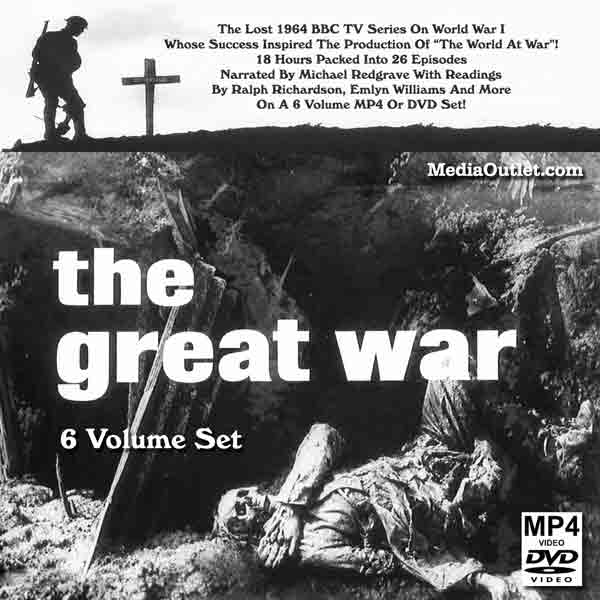
January 23, 1920: The European Civil War:
World War I: The First European War (The European Theater Of World
War I): The Aftermath Of World War I: The Fourteen Points: The
Abdication Of Wilhelm II: The Exile Of Wilhelm II: -- The
Netherlands refuses to surrender the exiled Kaiser Wilhelm II Of
Germany to the Allies. Wilhelm was at the Imperial Army
headquarters in Spa, Belgium, when the uprisings in Berlin and
other centres took him by surprise in late 1918. Mutiny among the
ranks of his beloved Kaiserliche Marine, the imperial navy,
profoundly shocked him. After the outbreak of the German
Revolution, Wilhelm could not make up his mind whether or not to
abdicate. Up to that point, he accepted that he would likely have
to give up the imperial crown, but still hoped to retain the
Prussian kingship. However, this was impossible under the imperial
constitution. Wilhelm thought he ruled as emperor in a personal
union with Prussia. In truth, the constitution defined the empire
as a confederation of states under the permanent presidency of
Prussia. The imperial crown was thus tied to the Prussian crown,
meaning that Wilhelm could not renounce one crown without
renouncing the other. Wilhelm's hope of retaining at least one of
his crowns was revealed as unrealistic when, in the hope of
preserving the monarchy in the face of growing revolutionary
unrest, Chancellor Prince Max of Baden announced Wilhelm's
abdication of both titles on 9 November 1918. Prince Max himself
was forced to resign later the same day, when it became clear that
only Friedrich Ebert, leader of the SPD, could effectively exert
control. Later that day, one of Ebert's secretaries of state
(ministers), Social Democrat Philipp Scheidemann, proclaimed
Germany a republic. Wilhelm consented to the abdication only after
Ludendorff's replacement, General Wilhelm Groener, had informed
him that the officers and men of the army would march back in good
order under Paul Von Hindenburg's command, but would certainly not
fight for Wilhelm's throne on the home front. The monarchy's last
and strongest support had been broken, and finally even
Hindenburg, himself a lifelong royalist, was obliged, with some
embarrassment, to advise the Emperor to give up the crown. The
fact that the High Command might one day abandon the Kaiser had
been foreseen in December 1897, when Wilhelm had visited Otto Von
Bismarck for the last time. Bismarck had again warned the Kaiser
about the increasing influence of militarists, especially of the
admirals who were pushing for the construction of a battle fleet.
Bismarck's last warning had been: "Your Majesty, so long as
you have this present officer corps, you can do as you please. But
when this is no longer the case, it will be very different for
you." Subsequently, Bismarck had predicted accurately: (The
Battle Of) Jena came twenty years after the death of Frederick The
Great; the crash will come twenty years after my departure if
things go on like this." On 10 November, Wilhelm crossed the
border by train and went into exile in the Netherlands, which had
remained neutral throughout the war. Upon the conclusion of the
Treaty Of Versailles in early 1919, Article 227 expressly provided
for the prosecution of Wilhelm "for a supreme offence against
international morality and the sanctity of treaties", but the
Dutch government refused to extradite him, despite appeals from
the Allies. King George V wrote that he looked on his cousin as
"the greatest criminal in history", but opposed Prime
Minister David Lloyd George's proposal to "hang the Kaiser".
It was reported, however, that there was little zeal in Britain to
prosecute. On January 1, 1920, it was stated in official circles
in London that Great Britain would "welcome refusal by
Holland to deliver the former kaiser for trial," and it was
hinted that this had been conveyed to the Dutch government through
diplomatic channels. "Punishment of the former kaiser and
other German war criminals is worrying Great Britain little",
it was said. As a matter of form, however, the British and French
governments were expected to request Holland for the former
kaiser's extradition. Holland, it was said, will refuse on the
ground of constitutional provisions covering the case and then the
matter will be dropped. The request for extradition will not be
based on genuine desire on the part of British officials to bring
the kaiser to trial, according to authoritative information, but
is considered necessary formality to 'save the face' of
politicians who promised to see that Wilhelm was punished for his
crimes." President Woodrow Wilson of the United States
opposed extradition, arguing that prosecuting Wilhelm would
destabilise international order and lose the peace. Wilhelm first
settled in Amerongen, where on 28 November he issued a belated
statement of abdication from both the Prussian and imperial
thrones, thus formally ending the Hohenzollerns' 500-year rule
over Prussia. Accepting the reality that he had lost both of his
crowns for good, he gave up his rights to "the throne of
Prussia and to the German Imperial throne connected therewith."
He also released his soldiers and officials in both Prussia and
the empire from their oath of loyalty to him. He purchased a
country house in the municipality of Doorn, known as Huis Doorn,
and moved in on 15 May 1920. This was to be his home for the
remainder of his life. The Weimar Republic allowed Wilhelm to
remove twenty-three railway wagons of furniture, twenty-seven
containing packages of all sorts, one bearing a car and another a
boat, from the New Palace at Potsdam. On Sale @ 15% Off Discount
Till Midnight PT!
https://store.earthstation1.com/the-great-war-dvd-set-1964-wwi-tv-series-26-shows-1964266.html
Today's
EarthStation1.com 15% Off Commemorative Memorial Title: Monster: A
Portrait Of Stalin In Blood TV Series DVD, Download, USB
Today, January 23, 2026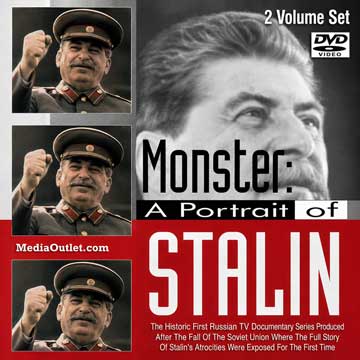
January 23, 1937: The Interwar Period
(The Aftermath Of World War I, The Interbellum, Between The Wars):
The Soviet Union (The Union Of Soviet Socialist Republics, USSR):
The History Of The Soviet Union: Mass Repression In The Soviet
Union: Purges Of The Communist Party Of The Soviet Union:
Stalinism: The Great Purge (The Great Terror [Russian: Bol'shoy
Terror, "The Big Terror"], The Year Of '37, The
Yezhovshina [Russian: "The Period Of Yezhov" {Nikolai
Yezhov}]): The Moscow Trials (The Moscow Show Trials): The Second
Moscow Trial (The Second Moscow Show Trial): The Case Of The
Anti-Soviet Trotskyist Center (The Pyatakov-Radek Trial): -- In
Moscow, 17 lesser figures of the Soviet communist party including
Karl Radek, Yuri Pyatakov and Grigory Sokolnikov go on a show
trial; Alexander Beloborodov was also arrested and intended to be
tried along with Radek, but did not make the confession required
of him, and so he was not produced in court. Thirteen of the
defendants were eventually executed by shooting. The rest received
sentences in labour camps. Radek was spared as he implicated
others, including Nikolai Bukharin, Alexei Rykov, and Marshal
Mikhail Tukhachevsky, setting the stage for two further trials:
the Third Moscow Show Trial (The Case Of the Anti-Soviet "Bloc
of Rights And Trotskyites" (Bukharin-Rykov Trial, or "Trial
of the Twenty-One;" 1938), and the secret trial now known as
The Case of the Trotskyist Anti-Soviet Military Organization (The
Military Case, The Tukhachevsky Case, The Military Trial, June
11-12, 1937). There were in all three Moscow Trials, including 1)
The Case Of The Trotskyite-Zinovievite Terrorist Center
(Zinoviev-Kamenev Trial, or the "Trial of the Sixteen",
August 19-24, 1936); 2) The Case Of The Anti-Soviet Trotskyist
Center (The Pyatakov-Radek Trial, January 23-30, 1937); and 3) The
Case Of the Anti-Soviet "Bloc of Rights And Trotskyites"
(Bukharin-Rykov Trial, or "Trial of the Twenty-One",
March 1938). The Prosecutor General for all three trials was
Andrei Vyshinsky, who was a future Soviet Ambassor to the United
Nations who famously spared with Adlai Stevenson during the Cuban
Missile Crisis, and was also a former member of the Mensheviks who
in 1917 had signed an order to arrest Lenin. The defendants of
these were Old Bolshevik party leaders and top officials of the
Soviet secret police. Most defendants were charged under Article
58 of the RSFSR Penal Code with conspiring with the Western powers
to assassinate Stalin and other Soviet leaders, dismember the
Soviet Union, and restore capitalism. The Moscow Trials led to the
execution of many of the defendants. They are generally seen as an
attempt to rid the party of current or prior oppositionists,
especially but not exclusively Trotskyists, and any leading
Bolshevik cadre from the time of the Russian Revolution or
earlier, who might even potentially become a figurehead for the
growing discontent in the Soviet populace resulting from Stalin's
mismanagement of the economy. Stalin's hasty industrialization
during the period of the First Five Year Plan and the brutality of
the forced agricultural collectivization had led to an acute
economic and political crisis in 1928-1933, a part of the global
problem known as the Great Depression, and to enormous suffering
on the part of the Soviet workers and peasants. Stalin was acutely
conscious of this fact and took steps to prevent it taking the
form of an opposition inside the Communist Party of the Soviet
Union to his increasingly totalitarian rule. The Moscow Trials are
also part of The Great Purge, also known as The Great Terror, also
known as the Year of '37 and the Yezhovschina ('period of
Yezhov'), a campaign of general political repression throughout
the Soviet Union from 1936 to 1938. It involved a large-scale
repression of relatively wealthy peasants (kulaks); ethnic
cleansing operations against ethnic minorities; a purge of the
Communist Party, of government officials, and of the Red Army
leadership; widespread police surveillance; suspicion of
saboteurs; counter-revolutionaries; imprisonment; and arbitrary
executions. Historians estimate the total number of deaths due to
Stalinist repression in 1937-38 to be between 950,000 to 1.2
million. The "Kulak Operation" and the targeting of
national minorities were the main components of the Great Terror.
Together these two actions accounted for nine-tenths of the death
sentences and three-fourths of Gulag prison camp sentences. In the
Western world, Robert Conquest's 1968 book The Great Terror
popularized the phrase. Conquest's title itself was an allusion to
the period from the French Revolution known as The Reign Of Terror
(French: la Terreur, "the Terror"; from June to July
1794: la Grande Terreur, 'the Great Terror'). On Sale @ 15% Off
Discount Till Midnight PT!
https://store.earthstation1.com/monster-a-portrait-of-stalin-in-blood-dvd-tv-series-2-disc2.html
Today's
EarthStation1.com 15% Off Commemorative Memorial Title: Lindbergh:
Biography Of Charles Lindbergh Documentary DVD, MP4, USB
Today, January 23, 2026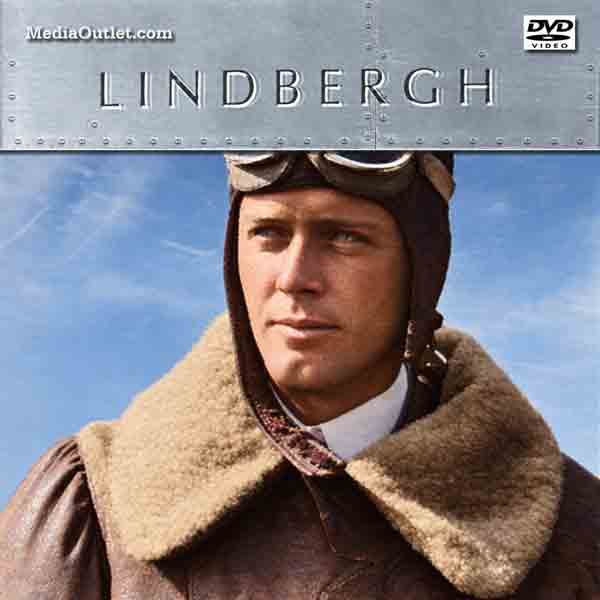
January 23, 1941: The Interwar Period
(The Aftermath Of World War I, The Interbellum, Between The Wars):
Appeasement: Charles Lindbergh: Charles Lindbergh's 1941 United
States House Committee On Foreign Affairs Testimony (Charles
Lindbergh's 1941 House Foreign Affairs Committee Testimony): --
Charles Lindbergh testifies before the U.S. Congress' the House
Committee on Foreign Affairs in opposition to the Lend-Lease Bill,
and recommends that the United States negotiate a neutrality pact
with Adolf Hitler. President Franklin Roosevelt publicly decried
Lindbergh's views as those of a "defeatist and appeaser",
comparing him to U.S. Rep. Clement L. Vallandigham, who had led
the "Copperhead" movement that had opposed the American
Civil War. Lindbergh promptly resigned his commission as a colonel
in the U.S. Army Air Corps, writing that he saw "no honorable
alternative" given that Roosevelt had publicly questioned his
loyalty. At an America First rally in September, Lindbergh accused
three groups of "pressing this country toward war: the
British, the Jewish, and the Roosevelt Administration". He
continued: "It is not difficult to understand why Jewish
people desire the overthrow of Nazi Germany. The persecution they
suffered in Germany would be sufficient to make bitter enemies of
any race. No person with a sense of the dignity of mankind can
condone the persecution of the Jewish race in Germany. But no
person of honesty and vision can look on their pro-war policy here
today without seeing the dangers involved in such a policy both
for us and for them. Instead of agitating for war, the Jewish
groups in this country should be opposing it in every possible way
for they will be among the first to feel its consequences.
Tolerance is a virtue that depends upon peace and strength.
History shows that it cannot survive war and devastations. A few
far-sighted Jewish people realize this and stand opposed to
intervention. But the majority still do not. Their greatest danger
to this country lies in their large ownership and influence in our
motion pictures, our press, our radio and our government... I am
not attacking either the Jewish or the British people. Both races,
I admire. But I am saying that the leaders of both the British and
the Jewish races, for reasons which are as understandable from
their viewpoint as they are inadvisable from ours, for reasons
which are not American, wish to involve us in the war. We cannot
blame them for looking out for what they believe to be their own
interests, but we also must look out for ours. We cannot allow the
natural passions and prejudices of other peoples to lead our
country to destruction.". Responding to criticism of his
speech. Lindbergh denied he was anti-Semitic but did not back away
from his positions. Anne Lindbergh felt that the speech might
tarnish Lindbergh's reputation unjustly; she wrote in her diary:
"I have the greatest faith in [Lindbergh] as a person, in his
integrity, his courage, and his essential goodness, fairness, and
kindness, his nobility really ... How then explain my profound
feeling of grief about what he is doing? If what he said is the
truth (and I am inclined to think it is), why was it wrong to
state it? He was naming the groups that were pro-war. No one minds
his naming the British or the Administration. But to name "Jew"
is un-American? - even if it is done without hate or even
criticism. Why?" Interventionists created pamphlets pointing
out his efforts were praised in Nazi Germany and included
quotations such as "Racial strength is vital; politics, a
luxury". They included pictures of him and other America
Firsters using the stiff-armed Bellamy salute (a hand gesture
described by Francis Bellamy to accompany his Pledge of Allegiance
to the American flag); the photos were taken from an angle not
showing the flag, so to observers it was indistinguishable from
the Hitler salute. Roosevelt disliked Lindbergh's outspoken
opposition to his administration's interventionist policies,
telling Treasury Secretary Henry Morgenthau, "If I should die
tomorrow, I want you to know this, I am absolutely convinced
Lindbergh is a Nazi." In 1941 he wrote to Secretary of War
Henry Stimson: "When I read Lindbergh's speech I felt that it
could not have been better put if it had been written by Goebbels
himself. What a pity that this youngster has completely abandoned
his belief in our form of government and has accepted Nazi methods
because apparently they are efficient." On Sale @ 15% Off
Discount Till Midnight PT!
https://store.earthstation1.com/lindbergh-1990-dvd-biography-documen1990.html
Today's
EarthStation1.com 15% Off Commemorative Memorial Title: The Battle
Of Guadalcanal DVD MP4 Download USB Flash Drive
Today, January 23, 2026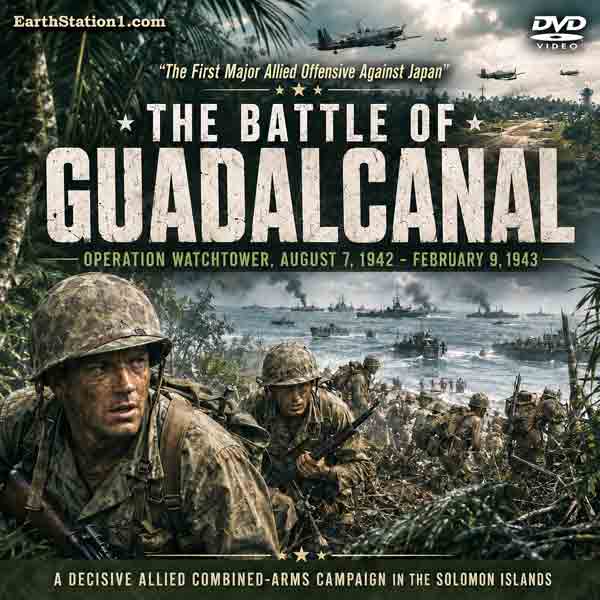
January 23, 1943: World War II: The
Pacific War (The Asia-Pacific War, The Asiatic-Pacific Theater,
The Pacific Theater Of World War II): The Pacific Ocean Theater Of
World War II: The South West Pacific Area (SWPA): Operation
Cartwheel: The Solomon Islands Campaign: The Battle Of Guadalcanal
(The Guadalcanal Campaign, Operation Watchtower): The Battle Of
Mount Austen, The Galloping Horse, And The Sea Horse (The Battle
Of The Gifu): -- The Battle Of Mount Austen, The Galloping Horse,
And The Sea Horse, part of which is sometimes called The Battle Of
The Gifu, ends after a five week battle between United States and
Imperial Japanese forces in the hills near the Matanikau River
area on Guadalcanal. Fought between December 15, 1942 and January
23 1943, the U.S. forces were under the overall command of
Alexander Patch and the Japanese forces were under the overall
command of Harukichi Hyakutake. In the battle, U.S. soldiers and
Marines (the 2nd Marine Division, 23rd Infantry Division, 25th
Infantry Division and 147th Infantry Regiment), assisted by native
Solomon Islanders, attacked Imperial Japanese Army (IJA) forces
(the 2nd Infantry Division, 38th Infantry Division and the 35th
Infantry Brigade) defending well-fortified and entrenched
positions on several hills and ridges. The most prominent hills
were called Mount Austen, the Galloping Horse, and the Sea Horse
by the Americans. The U.S. was attempting to destroy the Japanese
forces on Guadalcanal and the Japanese were trying to hold their
defensive positions until reinforcements could arrive. Both sides
experienced extreme difficulties in fighting in the thick jungles
and tropical environment of the battle area. Many of the American
troops were also involved in their first combat operations. The
Japanese were mostly cut off from resupply and suffered greatly
from malnourishment and lack of medical care. After some
difficulty, the U.S. succeeded in taking Mount Austen, in the
process reducing a strongly defended position called the Gifu, as
well as the Galloping Horse and the Sea Horse. In the meantime,
the Japanese decided to abandon Guadalcanal and withdrew to the
west coast of the island. From there most of the surviving
Japanese troops were successfully evacuated during the first week
of February 1943. On Sale @ 15% Off Discount Till Midnight PT!
https://store.earthstation1.com/the-battle-of-guadalcanal-dvd-mp4-download-usb-flash-driv4.html
Today's
EarthStation1.com 15% Off Commemorative Memorial Title: Axis
Armor: Tanks Of Nazi Germany Japan & Italy MP4 Video Download
DVD
Today, January 23, 2026
January 23, 1943: The European Civil War:
World War II: The Second European War (The European Theater Of
World War II): The North African Campaign: The Western Desert
Campaign (The Desert War): The Battle Of Tripoli: -- On the second
day of the two-day battle, Troops of Montgomery's Commonwealth
British Eighth Army capture Tripoli in Libya from Der
Deutsch-Italienische Panzerarmee (The German-Italian Panzer Army),
a combination of the German Afrika Korps with Italian units
commanded by Erwin Rommel of Germany and Ettore Bastico of Italy,
ending The Battle Of Tripoli. After a two-day short siege, the
Italian and German forces withdrew from Tripoli, and the Allies
entered the town to great worldwide fanfare. Tripoli was then
governed by the British until independence in 1951. Under the
terms of the 1947 peace treaty with the Allies, Italy relinquished
all claims to Libya. Tripoli had been controlled by Italy from
1911 until the provinces of Tripolitania and Cyrenaica were
captured by Allied forces. On Sale @ 15% Off Discount Till
Midnight PT!
https://store.earthstation1.com/axis-armor-tanks-of-nazi-germany-japan-amp-italy-mp4-video-download-dv4.html
Today's
EarthStation1.com 15% Off Commemorative Memorial Title: TV
Commercials: The Classics Vol. 3 DVD, Video Download, USB Drive
Today, January 23, 2026
January 23, 1957: Sports: World Games
Sports (Sports Of The World Games): Flying Dsc At The World Games:
Frisbee (Flying Disc, Disc): -- American inventor Walter Frederick
Morrison sells the rights to his flying disc to the Wham-O toy
company, which later renames it the "Frisbee". A frisbee
(pronounced FRIZ-bee, also called a flying disc or simply a disc)
is a gliding toy or sporting item that is generally plastic and
roughly 20 to 25 centimetres (8 to 10 in) in diameter with a
pronounced lip. It is used recreationally and competitively for
throwing and catching, as in flying disc games. The shape of the
disc, an airfoil in cross-section, allows it to fly by generating
lift as it moves through the air. Spinning it imparts a
stabilizing gyroscopic force, allowing it to be both aimed and
thrown for distance. A wide range of flying disc variants are
available. Those for disc golf are usually smaller but denser and
tailored for particular flight profiles to increase/decrease
stability and distance. The longest recorded disc throw is by
David Wiggins, Jr. with a distance of 338.0 meters (1,108.9 ft).
Disc dog sports use relatively slow flying discs made of more
pliable material to better resist a dog's bite and prevent injury
to the dog. Flying rings are also available; they typically travel
significantly farther than any traditional flying disc. On Sale @
15% Off Discount Till Midnight PT!
https://store.earthstation1.com/tv-commercials-the-classics-vol-3-dv3.html
Today's
EarthStation1.com 15% Off Commemorative Memorial Title: The
Fabulous Sixties with Peter Jennings TV Docuseries MP4 Or DVD Set
Today, January 23, 2026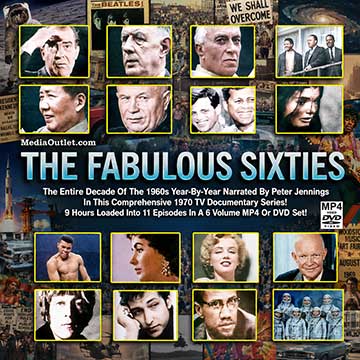
January 23, 1960: Deep-Submergence
Vehicles (DSVs): Bathyscaphes: Bathyscaphe Trieste: Project
Nekton: The Mariana Trench: The Challenger Deep: -- The
bathyscaphe USS Trieste breaks the world's underwater depth record
when it becomes the first crewed vessel to reach the bottom of the
Challenger Deep, the deepest known point of the seabed of Earth,
of the Mariana Trench near Guam in the Pacific Ocean, the deepest
oceanic trench on Earth, by descending to 10,911 metres (35,797
ft/6.7797 mi). The mission, the goal of Project Nekton, codename
for a series of test dives that culminated in this dive, was led
by Jacques Piccard, son of the boat's designer Auguste Piccard,
and US Navy Lieutenant Don Walsh commanding the USS Trieste, a
Swiss-designed, Italian-built, United States Navy-owned research
bathyscaphe. The project name was proposed by oceanographer Dr.
Robert S. Dietz in early 1958, as the project was being
contemplated, and it refers to the ocean life that actively swims
(nekton) as opposed to the plankton organisms that only drift in
the sea. Trieste was able to move independently, in contrast to
tethered bathyspheres, using two electric motors of 1.5 kilowatts
(2 hp) each, each with a propeller, . These allowed it to move
forward, backward and to turn horizontally. A maximum speed of one
knot (0.5 m/s) was attainable over a few miles distance. The
descent to the ocean floor took 4 hours and 48 minutes at a
descent rate of 0.914 m/s (3.29 km/h; 2.04 mph). After passing
30,000 feet/5.68 miles (9,000 m) one of the outer Plexiglas window
panes cracked, shaking the entire vessel. The two men spent barely
twenty minutes at the ocean floor, eating chocolate bars to keep
their strength. The temperature in the cabin was a mere 45 dg F (7
dg C) at the time. While on the bottom at maximum depth, Piccard
and Walsh unexpectedly regained the ability to communicate with
Wandank using a sonar/hydrophone voice communications system; at a
speed of almost one mile per second (1.6 km/s) (about five times
the speed of sound in air), it took about seven seconds for a
voice message to travel from the craft to the surface ship and
another seven seconds for answers to return. While on the bottom,
Piccard and Walsh reported they observed a number of small sole
and flounder swimming away, indicating that at least some
vertebrate life might withstand the extremes of pressure in any of
the Earth's oceans. They noted that the floor of the Challenger
Deep consisted of "diatomaceous ooze". The ascent to
surface took three hours, fifteen minutes. On Sale @ 15% Off
Discount Till Midnight PT!
https://store.earthstation1.com/decades-the-1960s-dvd-set-peter-jennings-tv-series-3-19603.html
Today's
EarthStation1.com 15% Off Commemorative Memorial Title: Eyes On
The Prize II: America At The Racial Crossroads DVD MP4 USB
Today, January 23, 2026
January 23, 1964: Civil Rights Movements:
The American Civil Rights Movement (1954-1968): Anti-Black Racism
In The United States: Segregation: Racial Segregation: Black
Suffrage (Black Political Franchise, Black Franchise, Black Right
To Vote, Black Active Suffrage): The Constitution Of The United
States: Twenty-fourth Amendment to the United States Constitution
(Amendment XXIV): -- The use of poll taxes in federal elections is
prohibited when the The 24th Amendment To The United States
Constitution is ratified by the states. The Twenty-fourth
Amendment (Amendment XXIV) of the United States Constitution
prohibits both Congress and the states from conditioning the right
to vote in federal elections on payment of a poll tax or other
types of tax. The amendment was proposed by Congress to the states
on August 27, 1962, and was ratified by the states on January 23,
1964. Southern states of the former Confederate States of America
adopted poll taxes in laws of the late 19th century and new
constitutions from 1890 to 1908, after the Democratic Party had
generally regained control of state legislatures decades after the
end of Reconstruction, as a measure to prevent African Americans
and often poor whites from voting. Use of the poll taxes by states
was held to be constitutional by the Supreme Court Of The United
States in the 1937 decision Breedlove v. Suttles. When the 24th
Amendment was ratified in 1964, five states still retained a poll
tax: Alabama, Arkansas, Mississippi, Texas and Virginia. The
amendment prohibited requiring a poll tax for voters in federal
elections. But it was not until 1966 that the U.S. Supreme Court
ruled 6-3 in Harper v. Virginia Board of Elections that poll taxes
for any level of elections were unconstitutional. It said these
violated the Equal Protection Clause of the Fourteenth Amendment.
Subsequent litigation related to potential discriminatory effects
of voter registration requirements has generally been based on
application of this clause. On Sale @ 15% Off Discount Till
Midnight PT!
https://store.earthstation1.com/eyes-on-the-prize-ii-dvd-set-4-discs-complete-2nd-seri42.html
Today's
EarthStation1.com 15% Off Commemorative Memorial Title: Pueblo TV
Docudrama 1968 North Korea Seizure Of USS Pueblo DVD MP4 USB
Today, January 23, 2026
January 23, 1968: Korea: The History Of
Korea: The Aftermath Of World War II: The Cold War: The Cold War
In Asia: The Korean Conflict: The Pueblo Incident (The Pueblo
Crisis): -- The USS Pueblo (AGER-2), a Banner-class environmental
research ship, attached to Navy intelligence as a spy ship, is
attacked and captured by North Korean forces. The seizure of the
U.S. Navy ship and its 83 crew members, one of whom was killed in
the attack, came less than a week after President Lyndon B.
Johnson's State Of The Union Address to the United States
Congress, a week before the start of the Tet Offensive in South
Vietnam during the Vietnam War, and three days after 31 men of
North Korea's KPA Unit 124 had crossed the Korean Demilitarized
Zone (DMZ) and killed 26 South Koreans in an attempt to attack the
South Korean Blue House (executive mansion) in the capital Seoul.
The taking of the Pueblo, and the abuse and torture of its crew
during the subsequent 11-month prisoner drama, became a major Cold
War incident, raising tensions between the western democracies and
the Soviet Union and China. North Korea stated that Pueblo
deliberately entered their territorial waters 7.6 nautical miles
away from Ryo Island, and that the logbook shows that they
intruded several times. However, the United States maintains that
the vessel was in international waters at the time of the incident
and that any purported evidence supplied by North Korea to support
its statements was fabricated. On December 23, 1968, the 82
surviving sailors from the USS Pueblo were released after eleven
months of internment in North Korea. Pueblo, still held by North
Korea today, officially remains a commissioned vessel of the
United States Navy. Since early 2013, the ship has been moored
along the Potong River in Pyongyang, and used there as a museum
ship at the Pyongyang Victorious War Museum. Pueblo is the only
ship of the U.S. Navy still on the commissioned roster currently
being held captive. On Sale @ 15% Off Discount Till Midnight PT!
https://store.earthstation1.com/pueblo-tv-drama-hal-holbrooke-dvd.html
Today's
EarthStation1.com 15% Off Commemorative Memorial Title:
Television: A History Of Broadcast TV DVD MP4 Download USB Drive
Today, January 23, 2026
January 23, 1977: Aesthetics: Performing
Arts: Premieres: Television Premieres: United States Television
Premieres: -- Roots, an American television miniseries based on
Alex Haley's 1976 novel Roots: The Saga of an American Family,
first airs on the ABC television network, running from January 23
to January 30, 1977. Roots received 37 Primetime Emmy Award
nominations and won nine. It also won a Golden Globe and a Peabody
Award. It received unprecedented Nielsen ratings for the finale,
which holds the record as the third-highest-rated episode for any
type of television series, and the second-most-watched overall
series finale in U.S. television history. It was produced on a
budget of 6.6M USD. A sequel, Roots: The Next Generations, first
aired in 1979, and a second sequel, Roots: The Gift, a Christmas
television film, starring Burton and Louis Gossett Jr., first
aired in 1988. A related film, Alex Haley's Queen, is based on the
life of Queen Jackson Haley, who was Alex Haley's paternal
grandmother. In 2016, a remake of the original miniseries, with
the same name, was commissioned by the History channel and
screened by the channel on Memorial Day. On Sale @ 15% Off
Discount Till Midnight PT!
https://store.earthstation1.com/television-1988-tv-documentary-series-8-shows-4-dual-laye198884.html
Today's
EarthStation1.com 15% Off Commemorative Memorial Title: Saddam's
War On Wildlife: Gulf War DVD, MP4 Download, USB Drive
Today, January 23, 2026
January 23-26, 1991: The Aftermath Of
World War II: The Cold War: The Cold War (1985-1991) (The End Of
The Cold War): The Gulf War (The Persian Gulf War, Gulf War I):
Operation Desert Storm: The Kuwaiti Oil Fires: -- As Iraq
continues to burn Kuwaiti oil fields, it dumps 400 million US
gallons of crude oil into the Persian Gulf, causing the largest
offshore oil spill in history at that time. It was reported as a
deliberate natural resources attack to keep U.S. Marines from
coming ashore (Missouri and Wisconsin had shelled Failaka Island
during the war to reinforce the idea that there would be an
amphibious assault attempt). About 30-40% of this came from allied
raids on Iraqi coastal targets. The Gulf War Oil Spill was one of
the largest oil spills in history. The apparent strategic goal was
to foil a potential landing by US Marines. It also made
commandeering oil reserves dangerous for US and Coalition forces
as visibility and movement were inhibited. The immediate reports
from Baghdad said that American airstrikes had caused a discharge
of oil from two tankers. Coalition forces determined the main
source of oil to be the Sea Island terminal in Kuwait. On January
26, three US F-117 fighter-bombers destroyed pipelines to prevent
further spillage into the Persian Gulf. Several other sources of
oil were found to be active: tankers and a damaged Kuwaiti oil
refinery near Mina Al Ahmadi, tankers near Bubiyan Island, and
Iraq's Mina Al Bakr terminal. The Gulf War (August 2, 1990 -
February 28, 1991), codenamed Operation Desert Shield (August 2,
1990 - January 17, 1991) for operations leading to the buildup of
troops and defense of Saudi Arabia, and Operation Desert Storm
(January 17, 1991 - February 28, 1991) in its combat phase, was a
war waged by coalition forces from 35 nations led by the United
States against Iraq in response to Iraq's invasion and annexation
of Kuwait. The war is also known under other names, such as the
Persian Gulf War, First Gulf War, Gulf War I, Kuwait War, First
Iraq War or Iraq War, before the term "Iraq War" became
identified instead with the 2003 Iraq War. On Sale @ 15% Off
Discount Till Midnight PT!
https://store.earthstation1.com/saddam39s-war-against-wildlife-gulf-war-dvd-mp4-download-usb-dr394.html
Today's
EarthStation1.com 15% Off Commemorative Memorial Title: Outer
Space Films 8 Project Voyager Pioneer Mariner DVD, Download, USB
Today, January 23, 2026
January 23, 2003: The History Of
Rocketry: The History Of Spaceflight: The Aftermath Of World War
II: The Cold War: The Space Age: The Space Race: The Discovery And
Exploration Of The Solar System: Space Probes: Interplanetary
Space Probes: The United States Space Program: Pioneer Program:
Pioneer 10: (Pioneer F): -- A very weak signal from Pioneer 10 is
detected for the last time, but no usable data can be extracted.
On December 3, 1973, Pioneer 10 sent back the first close-up
images of Jupiter. Pioneer 10 (originally designated Pioneer F) is
an American space probe, launched in 1972 and weighing 258
kilograms (569 pounds), that completed the first mission to the
planet Jupiter. Thereafter, Pioneer 10 became the first of five
artificial objects to achieve the escape velocity that will allow
them to leave the Solar System. This space exploration project was
conducted by the NASA Ames Research Center in California, and the
space probe was manufactured by TRW Inc. It was launched on March
2, 1972, by an Atlas-Centaur expendable vehicle from Cape
Canaveral, Florida. Between July 15, 1972, and February 15, 1973,
it became the first spacecraft to traverse the asteroid belt.
Photography of Jupiter began November 6, 1973, at a range of
25,000,000 kilometers (16,000,000 mi), and a total of about 500
images were transmitted. The closest approach to the planet was on
December 4, 1973, at a range of 132,252 kilometers (82,178 mi).
During the mission, the on-board instruments were used to study
the asteroid belt, the environment around Jupiter, the solar wind,
cosmic rays, and eventually the far reaches of the Solar System
and heliosphere. Radio communications were lost with Pioneer 10 on
January 23, 2003, because of the loss of electric power for its
radio transmitter, with the probe at a distance of 12 billion
kilometers (80 AU) from Earth. On Sale @ 15% Off Discount Till
Midnight PT!
https://store.earthstation1.com/outer-space-films-8-space-probe-projects-voyager-pioneer-mercury-dv8.html
Today's
EarthStation1.com #OnThisDay Commemorative Memorial Title: The
American Adventure: TV History Series 1607-1876 DVD MP4 USB Drive
Today, January 23, 2026 January 23: National Handwriting Day: --
January 23, 1737 (N.S.): #BOTD: #HBD! John Hancock, American
merchant, statesman, Founding Father and prominent Patriot of the
American Revolution (d. October 8, 1793) is #born in Braintree,
Massachusetts. He served as president of the Second Continental
Congress and was the first and third Governor of the Commonwealth
of Massachusetts. He is remembered for his large and stylish
signature on the United States Declaration Of Independence, so
much so that the term John Hancock has become a synonym in the
United States for one' signature. Before the American Revolution,
Hancock was one of the wealthiest men in the Thirteen Colonies,
having inherited a profitable mercantile business from his uncle.
He began his political career in Boston as a protege of Samuel
Adams, an influential local politician, though the two men later
became estranged. Hancock used his wealth to support the colonial
cause as tensions increased between colonists and Great Britain in
the 1760s. He became very popular in Massachusetts, especially
after British officials seized his sloop Liberty in 1768 and
charged him with smuggling. Those charges were eventually dropped;
he has often been described as a smuggler in historical accounts,
but the accuracy of this characterization has been questioned.
Hancock was one of Boston' leaders during the crisis that led to
the outbreak of the American Revolutionary War in 1775. He served
more than two years in the Continental Congress in Philadelphia,
and he was the first to sign the Declaration Of Independence in
his position as president of Congress. He returned to
Massachusetts and was elected governor of the Commonwealth,
serving in that role for most of his remaining years. He used his
influence to ensure that Massachusetts ratified the United States
Constitution in 1788.
https://store.earthstation1.com/the-american-adventure-series-us-1st-century-4-dv14.html
Today's
EarthStation1.com #OnThisDay Commemorative Memorial Title: The
Second Red Scare 1947-1957 Documentaries MP4 Video Download DVD
Today, January 23, 2026January 23, 1976: #DOTD: #RIP: Paul
Robeson, African American actor, singer, civil rights activist and
Prince Hall Freemason (b. April 9, 1898) #dies following
complications of a stroke in Philadelphia at the age of 77. He lay
in state in Harlem and his funeral was held at his brother Ben's
former parsonage, Mother Zion AME Zion Church, where Bishop J.
Clinton Hoggard performed the eulogy. His 12 pall bearers included
Harry Belafonte and Fritz Pollard. He is interred in Ferncliff
Cemetery in Hartsdale, New York. Paul Leroy Robeson was #born in
Princeton, New Jersey. Paul Leroy Robeson was an American bass
baritone singer and actor who became involved with the Civil
Rights Movement. At Rutgers College, he was an American football
player, and then had an international career in singing, as well
as acting in theater and movies. He became politically involved in
response to the Spanish Civil War, fascism, and social injustices.
His advocacy of anti-imperialism, affiliation with communism, and
criticism of the United States government caused him to be
blacklisted during the McCarthy era.
https://store.earthstation1.com/the-second-red-scare-19471957-documentaries-mp4-video-dow194719574.html
Today's
EarthStation1.com #OnThisDay Commemorative Memorial Title: Fifteen
Years Of MacNeil/Lehrer Anniversary Documentary DVD MP4 USB
Today, January 23, 2026( #JCKaelin here: Mr. James Charles
Lehrer (Jim Lehrer) maintained an email correspondence with James
Charles Kaelin (me, J.C. Kaelin) for a number of years, and he was
a customer as well (who really liked titles about trains! ;) ). He
especially liked that JC was a fan of the movie "Viva Max"
based on his novel of the same name, and he expressed much
gratitude to JC for his emailing support to him after the
unmerited criticism he received after the 2012 presidential
debates. God bless you Mr. Lehrer, the world is a much less
sensible place for your loss! #VivaMax!!!) ========= January 23,
2020: #DOTD: #RIP: Jim Lehrer, American journalist, novelist,
screenwriter, and playwright (b. May 19, 1934) #dies at his home
in Washington, D.C., at the age of 85 from a heart attack. His
remains were cremated, and his ashes were given to his widow Kate
Tom Staples Lehrer. Jim Lehrer was born James Charles Lehrer to
Lois Catherine (nee Chapman), who was a teacher, and Harry
Frederick Lehrer, a bus station manager. His paternal grandparents
were German immigrants. Jim Lehrer was the executive editor and a
news anchor for the PBS NewsHour on PBS, known for his role as a
debate moderator during U.S. presidential election campaigns. He
authored numerous fiction and non-fiction books that drew upon his
experience as a newsman, along with his interests in history and
politics.
https://store.earthstation1.com/fifteen-years-of-macneillehrer-anniversary-documentary-dvd-mp4-us4.html
Today's
EarthStation1.com #OnThisDay Commemorative Memorial Title: Captain
Kangaroo Starring Bob Keeshan TV Kid Shows DVD, MP4, USB Drive
Today, January 23, 2026(NOTE: #JCKaelin here: My parents were
friends of friends of Bob Keeshan while they were living in New
Hampshire and he was living in Vermont, and had the good fortune
to have spent time with him and dinner with him while my parents
lived there. They reported that he was as gracious as everyone
who's ever dealt with him likewise attest.) ========= January 23,
2004: #DOTD: #RIP: Bob Keeshan, American television personality,
producer and TV kid show host (b. June 27, 1927) #dies in Windsor,
Vermont, aged 76. He was survived by three children: Michael
Derek, Laurie Margaret, and Maeve Jeanne. His wife of 45 years,
Anne Jeanne Laurie Keeshan, died February 25, 1996. Keeshan's
grandson, Britton Keeshan, became the youngest person at that time
to have climbed the Seven Summits by climbing Mount Everest in May
2004. He carried photographs of his grandfather on that ascent,
and buried a photo of the two of them at the summit. Keeshan was
buried in Saint Joseph's Cemetery in Babylon, New York. Born
Robert James Keeshan in Lynbrook, New York. he created and played
the title role in the children' television program Captain
Kangaroo, which ran from 1955 to 1984, the longest-running
nationally broadcast children' television program of its day.
Keeshan also played the original Clarabell the Clown on the Howdy
Doody television program. After an early graduation from Forest
Hills High School in Queens, New York, in 1945, during World War
II, he enlisted in the United States Marine Corps Reserve, but was
still in the United States when Japan surrendered. He attended
Fordham University on the GI Bill. Network television programs
began shortly after the end of the war. Howdy Doody, an early show
which premiered in 1947 on NBC, was one of the first. Debuting on
January 3, 1948, Keeshan played Clarabell the Clown, a silent
Auguste clown who communicated by honking several horns attached
to a belt around his waist. One horn meant "yes"; two
meant "no". Clarabell often sprayed Buffalo Bob Smith
with a seltzer bottle and played practical jokes. Keeshan gave up
the role in 1952, and was replaced. By September 21, 1953, Keeshan
came back to local TV on WABC-TV, Channel 7 in New York City, in a
new children's show, Time for Fun. He played Corny the Clown, and
this time he spoke. Later that same year, in addition to Time for
Fun, Keeshan began Tinker's Workshop, a program aimed at
preschoolers, with him playing the grandfather-like Tinker.
Developing ideas from Tinker's Workshop, Keeshan and his long-time
friend Jack Miller submitted the concept of Captain Kangaroo to
the CBS network, which was looking for innovative approaches to
children's television programming. CBS approved the show, and
Keeshan starred as the title character when it premiered on CBS on
October 3, 1955. Keeshan described his character as based on "the
warm relationship between grandparents and children." The
show was an immediate success, and he served as its host for
nearly three decades. Recurring characters included his sidekick
(and fan favorite) Mr. Green Jeans (played by Hugh "Lumpy"
Brannum), Dennis (played by Cosmo Allegretti), and puppets such as
Bunny Rabbit and Mr. Moose, the pantomime Dancing Bear, and the
stylized longcase clock character Grandfather Clock. The New York
Times commented: "Captain Kangaroo, a round-faced, pleasant,
mustachioed man possessed of an unshakable calm ... was one of the
most enduring characters television ever produced." Keeshan
also had a Saturday morning show called Mister Mayor during the
1964-65 season. Keeshan, in his role as the central character in
both Captain Kangaroo and Mister Mayor, heavily promoted the
products of the Schwinn Bicycle Co., a sponsor, directly on-air to
his audience. By 1972, Keeshan had introduced another character on
Captain Kangaroo to recommend Schwinn products, Mr. Schwinn
Dealer, due to the Federal Trade Commission ruling against
children's show hosts directly endorsing their sponsor's products
during their programs after 1969. Keeshan had a longtime close
friendship with Fred Rogers of Mister Rogers' Neighborhood. Each
paid visits to the other's show (Keeshan on Mister Rogers'
Neighborhood and Rogers on Captain Kangaroo) in 1970, and the two
appeared together on the PBS special Springtime with Mister Rogers
in 1980. The following year, Fred Rogers appeared briefly in
Keeshan's TV special Good Evening, Captain (following Keeshan's
1981 heart attack), in which Rogers and Dick Clark both presented
Keeshan with flowers at the end of the show. Keeshan suffered a
severe heart attack just moments after stepping off a plane at
Toronto Pearson International Airport on July 11, 1981, which
pushed the start of a revamped version of his show back to at
least mid-August. He had come to the city to accept a children's
service award. Keeshan underwent triple-bypass surgery and
received an estimated 5,000 get-well wishes from fans during his
hospitalization. Following the heart attack, Keeshan received
three Emmy awards for Outstanding Performer in 1982, 1983, and
1984. Despite these accolades, Keeshan's show was shortened from
its hour-long format to 30 minutes in 1981, to make room for the
expansion of the CBS Morning News lineup. The program was retitled
Wake Up with the Captain, and moved to a new 7:00 am time slot. At
the start of 1982, the show was rescheduled to an even earlier
slot of 6:30 am. In the fall of 1982, CBS installed it as a
weekend-only hour offering, and two years later, in the fall of
1984, the show became a Saturday half-hour entry. Tired of CBS's
constant reductions of his show, Keeshan left Captain Kangaroo
when his contract with the network ended in December 1984, just
nine months shy of the show's 30th anniversary. By 1987, repeats
of the show were airing daily on many PBS stations. Keeshan's show
was given a farewell of sorts with Captain Kangaroo and Friends, a
primetime network TV special that aired in 1985. After Captain
Kangaroo ended, Keeshan hosted 1985's CBS Storybreak, which
featured animated versions of children's literature. Keeshan
appeared in framing sequences for the animated stories, showcasing
the book versions and suggesting similar books for the viewers to
seek out. In 1987, Keeshan founded Corporate Family Solutions with
former Tennessee Republican Governor Lamar Alexander. The company
provided day-care programs to businesses. Keeshan lived on Melbury
Road in Babylon Village, Long Island, New York, before moving to
spend the last 14 years of his life in Norwich, Vermont, where he
became a children's advocate, as well as an author. He published
his memoirs, entitled Good Morning, Captain, in 1995 by Fairview
Press. He was a strong advocate against video game violence and
took part in congressional hearings in 1993. In addition, he
joined with parents' groups in the 1980s who protested children's
TV shows based on toys like He-Man and Transformers; he felt that
toys turned into TV shows did not teach children anything about
the real world. He also made a rare film appearance in The
Stupids, a 1996 adventure comedy film starring Tom Arnold and
directed by John Landis. Keeshan was an adopted member of the
Dartmouth College class of 1942, receiving an honorary doctorate
from the college in 1975. He was also awarded an honorary doctor
of humane letters by Fordham University in 1975. Le Moyne College,
a Jesuit liberal arts college in Syracuse, New York, awarded him
an honorary doctor of humane letters in 1983. He was awarded an
honorary doctorate by the College of New Rochelle in 1985, after
serving for several years on its board of trustees. In 1997, he
received an honorary doctorate from Middlebury College, the alma
mater of his grandson Britton Keeshan, for his work in children's
literacy. That same year he starred as the Wizard in the St. Louis
Muny Outdoor Theater production of The Wizard Of Oz. In the 1990s,
Keeshan expressed an interest in bringing back a new version of
Captain Kangaroo as a gentler and kinder answer to the violent
cartoons on children's television. Despite having sponsors and
television stations lined up, Keeshan was unable to obtain
permission from ICM, the company that owned the rights to Captain
Kangaroo at that time.
https://store.earthstation1.com/captain-kangaroo-tv-show-bob-keeshan-dvd.html
Today's
EarthStation1.com #OnThisDay Commemorative Memorial Title: Million
Dollar Legs 1932 W. C. Fields & Jack Oakie DVD, MP4, USB Stick
Today, January 23, 2026January 23, 1978: #DOTD: #RIP: Jack
Oakie, American actor, starring mostly in films, but also working
on stage, radio and television, best remembered for portraying
Napaloni in Chaplin's The Great Dictator (1940), receiving a
nomination for the Academy Award for Best Supporting Actor (b.
November 12, 1903) #dies in Los Angeles, California at the age of
74 from an aortic aneurysm. His remains are interred at Forest
Lawn Memorial Park, Glendale in Los Angeles County. He was born
Lewis Delaney Offield in Sedalia, Missouri. His father, James
Madison Offield (1880-1939), was a grain dealer, and his mother,
Evelyn Offield (nee Jump) (1868-1939), was a psychology teacher.
When he was 5, the Offield family moved to Muskogee, Oklahoma, the
source of his "Oakie" nickname. His adopted first name,
Jack, was the name of the first character he played on stage.
Young Lewis/Jack grew up mostly in Oklahoma but also lived for
periods of time with his grandmother in Kansas City, Missouri.
While there he attended Woodland Elementary and made spending
money as a paperboy for The Kansas City Star. He recalled years
later that he made especially good money selling "extras"
in November 1916 during the presidential election campaign that
resulted in Woodrow Wilson being re-elected. Oakie worked as a
runner on Wall Street and narrowly escaped being killed in the
Wall Street bombing of September 16, 1920. While in New York, he
also started appearing in amateur theatre as a mimic and a
comedian, finally making his professional debut on Broadway in
1923 as a chorus boy in a production of Little Nellie Kelly by
George M. Cohan. Oakie worked in various musicals and comedies on
Broadway from 1923 to 1927, when he moved to Hollywood to work in
movies at the end of the silent film era. Oakie appeared in five
silent films during 1927 and 1928. As the age of the "talkies"
began, he signed with Paramount Pictures in 1927. He made his
first talking film, The Dummy, in 1929. When his contract with
Paramount ended in 1934, Oakie decided to freelance. He was
remarkably successful, appearing in 87 films, most made in the
1930s and 1940s. In the film Too Much Harmony (1933), the part of
Oakie's on-screen mother was played by his real mother, Mary
Evelyn Offield. During the 1930s, he was known as "The
World's Oldest Freshman", as a result of appearing in
numerous films with a collegiate theme. He was also known for
refusing to wear screen make-up of any kind, and the frequent use
of double-take in his comedy. Oakie was quoted as saying of his
studio career "The pictures I made were called the bread and
butter pictures of the studio. They cost nothing and made
millions, and supported the prestige productions that cost
millions and made nothing." Oakie portrayed Benzino Napaloni,
the boisterous dictator of Bacteria, in Charlie Chaplin's The
Great Dictator (1940), for which he received an Oscar nomination
for Best Supporting Actor. This role was a broad parody of the
fascist dictator of Italy, Benito Mussolini, then in power. Not
being limited by a film studio contract, Oakie branched into radio
and had his own radio show between 1936 and 1938. Late in his
career he appeared in various episodes of a number of television
shows, including The Real McCoys (1963, three times as Uncle
Rightly), Breaking Point (Episode #22 A Child of the Center
Ring,1964), Daniel Boone (1966), and Bonanza (1966). Oakie was
married twice. His first marriage to Venita Varden in 1936 ended
in 1938 when Venita got an interlocutory decree of divorce. They
reconciled, but finally divorced in 1944. She died in 1948 in the
crash of United Airlines Flight 624 at Mount Carmel, Pennsylvania.
Oakie's second marriage was in 1950, to actress Victoria Horne,
with whom he lived at "Oakridge" until his death in
1978. Jack and Victoria Oakie lived their entire married life at
"Oakridge", their 11-acre (45,000 m2) estate at 18650
Devonshire Street) in Northridge, a suburb of Los Angeles in the
San Fernando Valley. They acquired the former "Marwyck"
estate of actress Barbara Stanwyck in 1950. Stanwyck commissioned
the original residence designed by Paul Williams. Oakie planted a
citrus orchard and bred Afghan Hounds, at one time having up to
100 dogs on the property. Victoria Oakie continued to live there
after her husband's death and bequeathed the estate to the
University of Southern California, which sold it to developers.
After two failed attempts to develop the property, Oakridge was
acquired by the City of Los Angeles in December, 2009. Oakridge is
considered to be one of the last remnants of the large Northridge
equestrian estates, famed for former thoroughbred breeding. The
city plans to use the property as a park and community event
center. The Paul Williams house and the grounds are Los Angeles
Historic-Cultural Monument #484. In 1981, the "Jack Oakie
Lecture on Comedy in Film" was established as an annual event
of the Academy Of Motion Picture Arts And Sciences. At the
inaugural presentation, Oakie was described as "a master of
comic timing and a beloved figure in the industry." Jack
Oakie's star on the Hollywood Walk of Fame is at 6752 Hollywood
Boulevard, and his hand and footprints can be found at Grauman's
Chinese Theater in Hollywood. A small display celebrating the
comedy and fame of Jack Oakie is at Motion Picture &
Television Country House and Hospital in Woodland Hills,
California. There is a plaque in the ground in front of the home
where he was born in Sedalia, Missouri. Jack Oakie is mentioned in
the Coen Brothers film Barton Fink as the favorite actor of
Charlie, a character played by John Goodman.
https://store.earthstation1.com/million-dollar-legs-1932-dvd-wc-fields-jack-o1933.html
Today's
EarthStation1.com #OnThisDay Commemorative Memorial Title: Dwight
David Eisenhower: A Decent Man LP Record CD, MP3 Download, USB
Today, January 23, 2026January 23, 2024: #DOTD: #RIP: Charles
Osgood, American radio and television commentator, writer, and
musician, best known both for being the host of CBS News Sunday
Morning, a role he held for over 22 years from April 10, 1994,
until September 25, 2016, and The Osgood File, a series of daily
radio commentaries he hosted from 1971 until December 29, 2017,
co-composer of Senator Everett Dirksen's Grammy Award winning
spoken record song "Gallant Men" (d. January 8, 1933)
#dies from complications of dementia at his home in Saddle River,
New Jersey at age 91. His remains were cremated in a private
ceremony, and the ashes retained by his widow Jean Crafton. CBS
News Sunday Morning dedicated its full January 28, 2024, broadcast
to celebrating Osgood's life and work. Charles Osgood was born
Charles Osgood Wood III in Manhattan, New York City. Osgood was
also known for being the narrator of Horton Hears a Who!, an
animated film released in 2008, based on the book of the same name
by Dr. Seuss. He published a memoir of his boyhood in 2004. As a
child, he moved with his family to the Liberty Heights
neighborhood of Baltimore, Maryland. He attended St. Cecilia High
School in Englewood, New Jersey. His memoir about growing up in
Baltimore during World War II is called Defending Baltimore
Against Enemy Attack (2004) and in it he recounts his perspective
from age nine. Osgood graduated from Fordham University in 1954
with a Bachelor of Science degree in economics. While attending
Fordham, Osgood volunteered at the university's FM campus radio
station, WFUV. He often played piano between records on his shows
and frequently collaborated with other students, including future
actor Alan Alda and future producer and director Jack Haley, Jr.
Immediately after graduating from Fordham University, Osgood was
hired as an announcer by WGMS (AM) and WGMS-FM, the classical
music stations in Washington, D.C. (today WWRC and WTOP-FM
respectively). Shortly afterward, however, he enlisted in the
military to be the announcer for the United States Army Band. In
1991, he explained this turn of events in an interview with the
Los Angeles Times. He remarked "[After college graduation] I
went right to work for a classical musical [sic] station in
Washington called WGMS. I was an announcer. I learned a lot doing
that. I was about to be drafted in the Army, this was 1954, and I
ran into a guy while I was having dinner with a friend of mine and
he was dressed in a white uniform, the most fancy uniform this
side of the Ritz Hotel. It turned out he was the announcer for the
United States Army Band. I asked him when he was getting out and
he said within the next few weeks, so the next morning I was
parked out at the commanding officer's office. He was impressed
with the fact I could pronounce Rimsky-Korsakov. That's how I got
the job. I spent three years with the United States Army Band. It
was a great experience." Besides acting as the band's master
of ceremonies, he performed as a pianist with the band and sang
with the United States Army Band|United States Army Chorus. His
roommate, John Cacavas, composed arrangements for the band. They
would collaborate on many songs, a relationship that would
continue through the 1960s. In 1967, along with U.S. Senator
Everett Dirksen (R- Illinois), they shared a Grammy Award for best
spoken word performance for their single Gallant Men. As Dirksen
read a patriotic poem written by H. Paul Jeffers about the dignity
of duty in the armed forces, it was framed by Cacavas and Osgood's
martial music and stirring choral refrains. In 1967 it peaked at
number 16 on the Billboard 200 record chart. Stationed adjacent to
Arlington National Cemetery at Fort Myer during his service with
the U.S. Army Band, using pseudonyms, Osgood worked as an
announcer for radio stations in the Washington area to supplement
his income and experience. He hosted the morning show on WEAM
(WZHF today) as "Charlie Woods." At WGMS, he called
himself "Carl Walden." At WPGC (AM) (WJFK (AM) today), a
rock station, he referred to himself as "Chuck Forest."
In September 1955, President Dwight D. Eisenhower suffered a
serious heart attack during a vacation in Denver, Colorado, and
was confined to a hospital room there until November. During this
time, under the auspices of WGMS, Osgood hosted a closed-circuit
program of classical music delivered exclusively to the
president's room to encourage his relaxation and convalescence.
When his tour with the U.S. Army Band was completed, in October
1957, Osgood returned to WGMS full-time as announcer Charles Wood
and as a special assistant to the general manager. Before the end
of 1958, WGMS promoted him to program director. In 1960, credited
by name and as a WGMS announcer, he provided introductions and
commentary on a six-record album of a collection of thirty-three
speeches by President Franklin Delano Roosevelt titled FDR Speaks.
Edited by historian Henry Steele Commager, it included a welcome
by the president's widow, former first lady Eleanor Roosevelt.
Their son Franklin Delano Roosevelt, Jr. recited one of his
father's speeches. Billboard magazine reported that FDR Speaks
"was one of the most listened-to-attractions" at the
1960 Democratic National Convention which nominated senators John
F. Kennedy and Lyndon B. Johnson as its candidates for President
and Vice President of the United States. In April 1962, the parent
company of WGMS, RKO General, transferred Osgood to Hartford,
Connecticut, and promoted him to his first job in television: the
general manager of Channel 18, WHCT (WUVN today). WHCT was the
first TV station in the United States to be licensed to use
Phonevision, a system developed by Zenith that scrambled the
station's picture and sound. This limited viewing to paid
subscribers who were issued decoders attached to their television
sets and telephone lines. The station offered its subscribers
premium programming such as first-run movies, live sporting
events, and cultural programs like ballets and symphonies, all
with no commercials. Although RKO expected to operate WHCT at a
loss for the three years before the Federal Communications
Commission was due to renew the station's license, by early 1963,
the financial realities became too difficult to bear unabated. In
a 1985 interview with Broadcasting magazine, Osgood explained
"[The station] lost money at an alarming rate ... [RKO] let
me off the hook very gently. They said, "you're fired."
Unemployed at age 30, Osgood turned to one of his Fordham
classmates, Frank McGuire, who directed program development at ABC
in New York. In 1963, McGuire hired Osgood to be one of the
writers and hosts of Flair Reports, which related human interest
stories on the ABC Radio Network. "I went from being the
world's youngest station manager to being the world's oldest cub
reporter", he quipped in a 1981 interview with People
magazine. Another new McGuire hire for Flair Reports, whom Osgood
befriended at ABC, was Ted Koppel. While he was at ABC, he began
using the name "Charles Osgood" because the network
already had an announcer named "Charles Woods". In a
2005 interview with Inside Radio, Osgood related the story: "They
didn't want to have a Charles Woods and a Charles Wood. When they
told me to pick a name, I used my middle name as my last name.
It's worked out well and is a little more distinctive and
professional. Osgood moved over to CBS Radio in 1967 when it
became clear, in his words, that he "wasn't going anywhere"
at ABC. He worked as a reporter and anchor for WCBS. In August
1967, he anchored the first morning drive shift for WCBS after its
conversion to an all-news format. The first day of all-news
programming aired on WCBS-FM after an airplane crashed into the AM
station's antenna tower on New York's High Island, keeping WCBS
off air until a temporary tower could be erected. Osgood anchored
The Osgood File on of Westwood One, a daily commentary morning
show. It began as a segment on WCBS in 1967 and went national in
1971. Each three-minute Osgood File focused on a single story,
ranging from a breaking development of national importance to a
whimsical human-interest vignette. Some of those he did in rhyme,
which is why he was known as CBS's "Poet in Residence."
He continued these broadcasts until December 29, 2017. On
television, Osgood joined CBS News in 1971. He was a reporter, and
served as anchor of the CBS Sunday Night News from 1981 to 1987,
co-anchor of the weekday CBS Morning News and frequent news reader
on CBS This Morning from 1987 to 1992, as well as occasional
anchor of the CBS Afternoon News and the CBS Evening News with Dan
Rather. Osgood hosted CBS News Sunday Morning from April 10, 1994,
to September 25, 2016, succeeding the original host Charles
Kuralt. Osgood's tenure of twenty-two years as host exceeded
Kuralt's fifteen years. Among Osgood's personal trademarks were
his bow tie, his weekly TV signoff "Until then, I'll see you
on the radio", and his propensity for delivering his
commentaries in whimsical verse. Example: When the Census Bureau
invented a designation for cohabitant(s) as "Person(s) of
Opposite Sex Sharing Living Quarters", or "POSSLQ",
Osgood turned it into a pronounceable three-syllable word and
composed a prospective love poem that included these lines, which
he later used as the title of one of his books, "There's
nothing that I wouldn't do | If you would be my POSSLQ". On
December 21, 2017, it was announced Osgood would retire from The
Osgood File due to health concerns, ending his broadcast career.
His final broadcasts were on December 29, 2017. Osgood's first
marriage to Theresa Audette ended in divorce after 16 years. He
and his second wife, Jeanne Crafton, had five children, who were
raised in Englewood, New Jersey. When they became empty nesters,
Osgood and his wife moved to a 12-room duplex on West 57th Street
at 7th Avenue in New York City.
https://store.earthstation1.com/dwight-david-eisenhower-a-decent-man-lp-album-mp3-c3.html
Today's
EarthStation1.com #OnThisDay Commemorative Memorial Title: Funny
Business: A Stand Up Life Stand-Up Comedy MP4 Video Download DVD
Today, January 23, 2026January 23, 2005: #DOTD: #RIP: Johnny
Carson, American comedian and talk show host, best known for his
30 years as host of The Tonight Show Starring Johnny Carson
(1962-1992) (b. October 23, 1925) #dies aged 79 at Cedars-Sinai
Medical Center in Los Angeles of respiratory failure arising from
emphysema. His body was cremated, and the ashes were given to his
wife, Alexis Maas. In accordance with his family's wishes, no
public memorial service was held. Carson was also survived by his
younger brother, Dick, who was an Emmy Award-winning director of,
among other things, the competing Merv Griffin Show and Wheel of
Fortune. Numerous tributes were paid to Carson upon his death,
including a statement by then-President George W. Bush, all
recognizing the deep and enduring affection held for him. On
January 31, The Late Show With David Letterman paid tribute with
former Tonight Show executive producer Peter Lassally and
bandleader Doc Severinsen. At the beginning of this show,
Letterman said that for 30 years, no matter what was going on in
the world, whether people had a good or bad day, they wanted to
end it being "tucked in by Johnny." He also told his
viewers that the monologue he had just spoken, which was very well
received by the studio audience, consisted entirely of jokes sent
to him by Carson in the last few months of his life. Doc
Severinsen ended the Letterman show that night by conducting and
playing, along with Tommy Newsom and Ed Shaughnessy. The Tonight
Show with Jay Leno also paid tribute to Carson with guests Ed
McMahon, Bob Newhart, Don Rickles, Drew Carey, and k.d. lang. On
his final Tonight Show appearance, Carson himself said that while
sometimes people who work together for long stretches of time on
television do not necessarily like each other, this was not the
case with McMahon; he and McMahon were good friends who would have
drinks and dinner together, and the camaraderie they had on the
show could not be faked. Their friendship spanned 46 years. Johnny
Carson was born John William Carson in Corning, Iowa; in
recognition of Carson's birth, October 23 is annually recognized
as National TV Talk Show Host Day. Johnny Carson was born John
William Carson in Corning, Iowa, to Ruth Elizabeth (Hook) Carson
(1901-1985) and Homer Lloyd "Kit" Carson. Carson
received six Emmy Awards, the Television Academy's 1980 Governor's
Award, and a 1985 Peabody Award. He was inducted into the
Television Academy Hall of Fame in 1987. Carson was awarded the
Presidential Medal Of Freedom in 1992 and received a Kennedy
Center Honor in 1993. Although his show was already successful by
the end of the 1960s, it was during the 1970s Carson became an
American icon and remained so even after his retirement in 1992.
He adopted a casual, conversational approach with extensive
interaction with guests, an approach pioneered by Arthur Godfrey
and previous Tonight Show hosts Steve Allen and Jack Paar.
https://store.earthstation1.com/fubustlistco.html
Today's
EarthStation1.com #OnThisDay Commemorative Memorial Title: History
Of Talk Radio w/Lauren Hutton + Dateline: Howard Stern MP4 DVD
Today, January 23, 2026January 23, 2021: #DOTD: #RIP: Larry
King, American journalist, author, radio, television and talk show
host who conducted over 60,000 interviews on radio and TV, whose
awards included two Peabodys, an Emmy and 10 Cable ACE Awards (b.
November 19, 1933) #dies from sepsis shortly after he recovered
from a bout of COVID-19 at Cedars-Sinai Medical Center in Los
Angeles, California, aged 87. He is buried at Hillside Memorial
Park Cemetery, a Jewish cemetery in Culver City, California where
many Jews from the entertainment industry are buried. Larry King
was born Lawrence Harvey Zeiger in Brooklyn, New York into an
Orthodox Jewish family who immigrated to the United States from
modern day Belarus in the 1920s, one of two sons of Jennie (nee
Gitlitz), a garment worker who was born in Minsk, Russian Empire,
and Aaron Edward Zeiger, a restaurant owner and defense-plant
worker who was born in Pinsk, Russian Empire. King at Lafayette
High School, a public high school in Brooklyn. He was a WMBM radio
interviewer in the Miami area in the 1950s and 1960s and beginning
in 1978, gained national prominence as host of The Larry King
Show, an all-night nationwide call-in radio program heard over the
Mutual Broadcasting System. From 1985 to 2010, he hosted the
nightly interview television program Larry King Live on CNN. King
hosted Larry King Now from 2012 to 2020, which aired on Hulu, Ora
TV, and RT America. He hosted Politicking with Larry King, a
weekly political talk show, on the same three channels from 2013
to 2020. King also appeared in television series and films,
usually playing himself. He remained active until his death.
https://store.earthstation1.com/hioftarawila.html
Today's
EarthStation1.com #OnThisDay Commemorative Memorial Title: Things
To Come 1936 H.G. Wells Raymond Massey Ralph Richardson MP4 DVD
Today, January 23, 2026January 23, 1956: #DOTD: #RIP: Sir
Alexander Korda, Hungarian-English director, producer, and
screenwiter, founder of London Films and, post-war, the owner of
British Lion Films, producer of many outstanding classics of the
British film industry such as The Private Life of Henry VIII,
Rembrandt, Things To Come, The Thief of Baghdad and The Third Man
(b. September 16, 1893) #dies of a heart attack at the age of 62
at his home in London, England. He was cremated at Golders Green
Crematorium in London; his ashes were finally interred in February
1959 at Stoke Poges Memorial Gardens in Buckinghamshire, England.
Alexander Korda was born Sandor Laszlo Kellner into a Jewish
family in Pusztaturpaszto, Austria-Hungary. He began his career in
Hungary, he worked briefly in the Austrian and German film
industries during the era of silent films, before being based in
Hollywood during the transition to "talkies" from 1926
to 1930 for the first of his two brief periods there (the other
was during World War II). The change led to divorce from his first
wife, popular Hungarian actress Maria Corda, who could not make
the transition to "talkies" because of her strong accent
in English. From 1930, Korda became a leading figure in the
British film industry, the founder of London Films and the owner
of British Lion Films, a film distributing company. Korda was the
first filmmaker to have been knighted.
https://store.earthstation1.com/things-to-come-dvd-alexander-korda-h-g-wells.html
Today's
EarthStation1.com #OnThisDay Commemorative Memorial Title: Armed
Forces Radio Presents Jubilee! WWII Radio DVD, MP3 Download, USB
Today, January 23, 2026January 23, 1973: #DOTD: #RIP: Kid Ory,
Creole American jazz trombonist, composer, and bandleader (b.
December 25, 1886) #dies of pneumonia and a heart attack in
Honolulu at the age of 86. He is buried at Holy Cross Cemetery,
Culver City, California. Born Edward Ory on Woodland Plantation,
near LaPlace, Louisiana to a Louisiana French-speaking family, Ory
started playing music with homemade instruments in his childhood,
and by his teens was leading a well-regarded band in southeast
Louisiana. He kept LaPlace as his base of operations because of
family obligations until his twenty-first birthday, when he moved
his band to New Orleans. He was one of the most influential
trombonists of early jazz. Ory was a banjo player during his
youth, and it is said that his ability to play the banjo helped
him develop "tailgate", a particular style of playing
the trombone with a rhythmic line underneath the trumpets and
cornets. When Ory was living on Jackson Avenue, he was discovered
by Buddy Bolden, playing his first new trombone, instead of an old
Civil War trombone. Ory's sister said he was too young to play
with Bolden. Ory had one of the best-known bands in New Orleans in
the 1910s, hiring many of the great jazz musicians of the city,
including the cornetists Joe "King" Oliver, Mutt Carey,
and Louis Armstrong, who joined the band in 1919; and the
clarinetists Johnny Dodds and Jimmie Noone. In 1919, he moved to
Los Angeles, one of a number of New Orleans musicians to do so
near that time, and he recorded there in 1921 with a band that
included Mutt Carey, the clarinetist and pianist Dink Johnson, and
the string bassist Ed Garland. Garland and Carey were longtime
associates who would still be playing with Ory during his 1940s
comeback. While in Los Angeles, Ory and his band recorded two
instrumentals, "Ory's Creole Trombone" and "Society
Blues", as well as a number of songs. They were the first
jazz recordings made on the West Coast by an African American jazz
band from New Orleans, Louisiana. His band recorded with Nordskog
Records; Ory paid Nordskog for the pressings and then sold them
with his own label, "Kid Ory's Sunshine Orchestra", at
Spikes Brothers Music Store in Los Angeles. In 1925, Ory moved to
Chicago, where he was very active, working and recording with
Louis Armstrong, Jelly Roll Morton, Oliver, Johnny Dodds, Bessie
Smith, Ma Rainey, and many others. He mentored Benny Goodman and,
later, Charles Mingus. He was said to have attempted to take
trombone lessons from a "German guy" who played in the
Chicago symphony, but Ory was turned away after a few lessons. Ory
was notably a part of the original configuration of Louis
Armstrong's Hot Five, first recorded on November 12, 1925. His
famous composition "Muskrat Ramble" was included in the
Hot Five session in February 1926. During the Great Depression Ory
retired from music and did not play again until 1943. He ran a
chicken farm in Los Angeles, California. From 1944 to about 1961
he led one of the top New Orleans-style bands of the period. His
sidemen during this period included, In addition to Carey and
Garland, the trumpeters Alvin Alcorn and Teddy Buckner; the
clarinetists Darnell Howard, Jimmie Noone, Albert Nicholas, Barney
Bigard, and George Probert; the pianists Buster Wilson, Cedric
Haywood, and Don Ewell; and the drummer Minor Hall. All but
Buckner, Probert, and Ewell were originally from New Orleans. The
Ory band was an important force in reviving interest in New
Orleans jazz, making popular 1940s radio broadcasts-among them a
number of slots on The Orson Welles Almanac program (beginning
March 15, 1944). In 1944-45 the group made a series of recordings
for Crescent Records, which was founded by Nesuhi Ertegun for the
express purpose of recording Ory's band. During the late 1940s and
early 1950s, Ory and his group appeared at the Beverly Cavern in
Los Angeles. In 1958 he played at 'On the levee' on the waterfront
at San Francisco. Ory retired from music in 1966 and spent his
last years in Hawaii, with the assistance of Trummy Young. Ory was
Catholic, baptized at St Peter Church.
https://store.earthstation1.com/armed-forces-radio-presents-jubilee-otr-jazz-music-mp3-dv3.html
Today's
EarthStation1.com #OnThisDay Commemorative Memorial Title: Antony
and Cleopatra (1991) DVD, MP4 Video Download, USB Flash Drive
Today, January 23, 2026January 23, 1981: #DOTD: #RIP: Samuel
Barber, American pianist and composer of orchestral, opera,
choral, and piano music (b. March 9, 1910) #dies from cancer at
his 907 Fifth Avenue apartment in Manhattan at the age of 70;
Barber had been hospitalized on and off between 1978 and 1981
while undergoing treatment for the disease. His funeral was held
at the First Presbyterian Church of West Chester three days later,
and he was buried in the Oaklands Cemetery there. His final
composition, Canzone for oboe and string orchestra (1981), was
published after his death; initially intended to be a fully
developed oboe concerto, Barber only completed the second movement
of that work. Samuel Barber was born Samuel Osmond Barber II in
West Chester, Pennsylvania. One of the most celebrated composers
of the 20th century, Barber's music usually eschewed the
experimental trends of musical modernism in favor of traditional
19th-century harmonic language and formal structure embracing
lyricism and emotional expression. However, he adopted elements of
modernism after 1940 in some of his compositions, such as an
increased use of dissonance and chromaticism in the Cello Concerto
(1945) and Medea's Dance of Vengeance (1955); and the use of tonal
ambiguity and a narrow use of serialism in his Piano Sonata
(1949), Prayers of Kierkegaard (1954), and Nocturne (1959). Barber
was adept at both instrumental and vocal music. His works became
successful on the international stage and many of his compositions
enjoyed rapid adoption into the classical performance canon. In
particular, his Adagio for Strings (1936) has earned a permanent
place in the orchestral concert repertory, as has that work's
adaptation for chorus, Agnus Dei (1967). He received the Pulitzer
Prize for Music twice: for his opera Vanessa (1956-57), and for
the Concerto for Piano and Orchestra (1962). Also widely performed
is his Knoxville: Summer of 1915 (1947), a setting for soprano and
orchestra of a prose text by James Agee. At the time of Barber's
death, nearly all of his compositions had been recorded. Many of
his compositions were commissioned or first performed by such
noted groups and artists as the Boston Symphony Orchestra, the
Philadelphia Orchestra, the New York Philharmonic, the
Metropolitan Opera, Vladimir Horowitz, Eleanor Steber, Raya
Garbousova, John Browning, Leontyne Price, Pierre Bernac, Francis
Poulenc, and Dietrich Fischer-Dieskau. While Barber composed a
significant body of purely instrumental music, two-thirds of his
compositional output was art songs for voice and piano, choral
music, and songs for voice and orchestra. Some of his most
frequently performed songs include both the solo voice and choral
versions of Sure on this shining night (solo version from 1938 and
choral version from 1961) with text by Agee; and the song cycle
Hermit Songs (1953), with anonymous texts by Irish monks from the
eighth through thirteenth centuries. This emphasis on sung
material was rooted in his own brief career as a professional
baritone in his 20s which inspired a lifelong love of vocal music.
In 1935, Barber recorded his own setting of Arnold's "Dover
Beach" for NBC, accompanying his own singing voice, and was
also featured weekly on NBC Radio in 1935-1936 performing of
German lieder and art songs. He also occasionally conducted
performances and recordings of his works with symphony orchestras
during the 1950s, and taught composition at the Curtis Institute
from 1939-1942. Barber was in a relationship with the composer
Gian Carlo Menotti for more than 40 years. They lived at
Capricorn, a house just north of New York City, where they
frequently hosted parties with academic and music luminaries.
Menotti was Barber's librettist for two of his three operas. When
the relationship ended in 1970, they remained close friends until
Barber's death.
https://store.earthstation1.com/antony-amp-cleopatra-samuel-barber39s-opera-shakespeare39s-words3939.html
Today's
EarthStation1.com #OnThisDay Commemorative Memorial Title: TV
Music & Dance Shows #13 Byrds Kingsmen Hondells DVD MP4 Flash
Drive
Today, January 23, 2026January 23, 1997: #DOTD: #RIP: Richard
Berry, Jr., African American singer, songwriter and musician who
performed with many Los Angeles doo-wop and close harmony groups
in the 1950s, including the Flairs and the Robins, best known as
the composer and original performer of the rock standard "Louie
Louie", the most recorded rock song of all time (b. April 11,
1935) #dies of heart failure aged 61 in Inglewood, California. He
is interred in the Inglewood Park Cemetery in Inglewood. Richard
Berry was born Richard Berry Jr. in Extension, south of Monroe,
Louisiana; his birthday is celebrated as International Louie Louie
Day. He moved with his family to Los Angeles as a baby. As a
child, he suffered a hip injury and had to walk on crutches until
he was six. He began singing and playing in local doo-wop groups,
recording with a number of them including the Penguins, the
Cadets, the Chimes, the Crowns, the Five Hearts, the Hunters, the
Rams, the Whips, and the Dreamers, an otherwise all-female quartet
from Fremont High. He then joined the Flairs (who also recorded as
the Debonaires and the Flamingoes) in 1953. The Flairs' 1953
record "She Wants to Rock" on Modern Records featured
Berry's bass vocals, and was an early production by Leiber and
Stoller. A few months later, when the producers needed a bass
voice for the Robins' "Riot In Cell Block #9" on Spark
Records, they recruited Berry to provide the menacing lead vocal
on the song - uncredited because he was contracted to Modern.
Berry's voice was used at Modern, again uncredited, as the
counterpoint to Etta James on her first record and big hit "The
Wallflower (Dance with Me, Henry)" and several of its less
successful follow-ups. Berry also recorded with several other
groups on the Modern and Flair labels, including Arthur Lee Maye
and the Crowns, and the Dreamers (who later became the Blossoms).
By the end of 1954, Berry left the Flairs to form his own group,
the Pharaohs, as well as continued to work with other groups as a
singer and songwriter. In 1955, Berry was inspired to write "Louie
Louie", a calypso-style song, based on the Rhythm Rockers'
version of Rene Touzet's "El Loco Cha Cha", as well as
influenced by Chuck Berry's "Havana Moon". Berry also
stated he had Frank Sinatra's "One for My Baby" in mind
when writing the lyrics. One night while waiting backstage at
Anaheim's Harmony Park Ballroom, Berry took the rhythm of "El
Loco Cha Cha" and began to add lyrics, writing them on toilet
paper. Richard Berry and the Pharaohs recorded and released the
song as the B-side to his cover of "You Are My Sunshine"
on Flip Records in 1957. It became a minor regional hit, selling
130,000 copies. It was re-released as an A-side, and when the
group toured the Pacific Northwest, several local R & B bands
began to adopt the song and established its popularity. "Louie
Louie" finally became a major hit when the Kingsmen's raucous
version - with little trace of its calypso-like origins other than
in its lyrics - became a national and international hit in 1963.
Paul Revere & the Raiders also recorded the tune in the same
studio the week after the Kingsmen, but their version was not a
hit. The nearly unintelligible (and innocuous) lyrics were widely
misinterpreted as obscene, and the song was banned by radio
stations and even investigated by the Federal Bureau of
Investigation. The song has been recorded over 1,000 times.
However, Berry received little financial reward for its success
for many years, having sold the copyright for 750 USD in 1959 to
pay for his wedding. Berry said in 1993 "Everybody sold their
songs in those days. I never was bitter with the record companies.
They provided a vehicle for five young black dudes to make a
record." Berry continued to write and record into the early
1960s, including "Have Love, Will Travel" (which later
became a local hit for the Sonics), but with little commercial
success, and also continued as a performer. Other songs included
"Crazy Lover", recorded by the Rollins Band and "Oh!
Oh! Get Out of the Car", covered by the Treniers. For Rhino's
1983 The Best of Louie, Louie compilation album, Berry created a
note-for-note re-recording of "Louie Louie" because
licensing could not be obtained for the original version. Backup
vocals were provided by doo wop revival group Big Daddy. The
original version was not legitimately re-released until the Ace
Records Love That Louie compilation in 2002. In the mid-1980s,
Berry was living on welfare at his mother's house in South Central
Los Angeles. Drinks company California Cooler wanted to use "Louie
Louie" in a commercial, but discovered it needed Berry's
signature to use the song. The company asked the Artists Rights
Society to locate him, and a lawyer visited Berry. The lawyer
mentioned the possibility of Berry's taking action to gain the
rights to his song. The publishers settled out of court, making
Berry a millionaire. In the early 1980s, Berry recorded a duet
with his ex-wife Dorothy titled 'The World Needs Peace'. He
re-recorded it a few years later in a gospel version retitled
"What We Need", with his six children providing backup
harmony vocals. During the 1980s, "Louie Louie" received
a number of accolades, with hundreds of cover versions issued on
CD compilations and played on radio marathons. He continued to
play shows and in 1993 played two sets at the 100 Club in London.
Berry married Dorothy Adams, a girl with whom he attended high
school, in 1957, and they had two children, Pam and Marcel. They
divorced in 1968. Dorothy pursued a music career, recording for
Garpax Records, Challenge Records, Little Star Records and
Tangerine. She was a Raelette for Ray Charles until the early
1980s. Berry had six children in total, Pamela, Richard Marcel,
Stephani, Karen, Linda and Christy. Christy, who was born in 1969,
handled his career in his later years. Marcel played bass on stage
with his father in the 1980s. In February 1996, Berry performed
for the final time, reuniting with the Pharaohs and the Dreamers
for a benefit concert in Long Beach, California. His health
declined shortly afterward, resulting in his death.
https://store.earthstation1.com/classic-tv-music-amp-dance-shows-13-byrds-kingsmen-hondells-d13.html
Today's
EarthStation1.com #OnThisDay Commemorative Memorial Title: WABC
Radio Airchecks MP3 Collection 1960s-1980s DVD, MP3 Download, USB
Today, January 23, 2026January 23, 2024: #DOTD: #RIP: Melanie
Anne Safka-Schekeryk, professionally known as Melanie or Melanie
Safka, American, singer and songwriter, best known for the 1971-72
global hit "Brand New Key", her cover of "Ruby
Tuesday", her composition "What Have They Done to My
Song Ma", and her 1970 international breakthrough hit "Lay
Down (Candles in the Rain)" (inspired by her experience of
performing at the 1969 Woodstock music festival) (b. February 3,
1947) dies at age 76 in the Nashville metropolitan area where
Melanie resided. Her three children shared their mother's death in
a Facebook post and her reps mentioned "an illness", but
no cause was given. She is buried at Larkspur Conservation At
Taylor Hollow cemetery in Westmoreland, Tennessee. Melanie was
born Melanie Anne Safka in the Astoria neighborhood of Queens, New
York City to Frederick M. Safka (1924-2009) of Ukrainian and
Russian ethnic background and jazz singer Pauline "Polly"
Altomare (1926-2003) of Italian heritage. Schekeryk She moved with
her family to Long Branch, New Jersey, and attended Long Branch
High School. Bothered by being pegged by her classmates as a
"beatnik" in school, she ran away to California and,
after her return to New Jersey, transferred to Red Bank Regional
High School in Red Bank, New Jersey; she graduated in 1964, though
she was blocked from attending her commencement exercise due to an
overdue library book. In the 1960s, Melanie started performing at
The Inkwell, a coffee house in the West End section of Long
Branch. After high school, her parents insisted that she go to
college, so she studied acting at the American Academy of Dramatic
Arts in New York, where she began singing in the folk clubs of
Greenwich Village, such as The Bitter End, and signed her first
recording contract. She was one of only three solo women who
performed at the Woodstock festival in 1969 and the inspiration
for her first hit song, "Lay Down (Candles in the Rain)",
apparently arose from the Woodstock audience lighting candles
during her set (although most of the "candles" were
actually matches or lighters). The recording became a hit in
Europe, Australia, Canada, and the United States in 1970. In 1970,
Melanie was the only artist to ignore the court injunction banning
the Powder Ridge Rock Festival scheduled to be held on July 31,
August 1 and 2, 1970. She played for the crowd on a homemade stage
powered by Mister Softee trucks. In 1971, she formed her own
label, Neighborhood Records, with Peter Schekeryk who was also her
producer and husband. She had her biggest American hit on the
Neighborhood label, the novelty-sounding 1972 number one "Brand
New Key" (often referred to as "The Roller Skate Song").
"Brand New Key" sold over three million copies worldwide
and was featured in the 1997 movie Boogie Nights. When first
released, "Brand New Key" was banned by some radio
stations because some heard sexual innuendo in the lyrics. Melanie
has acknowledged the possibility of reading an unintended sexual
innuendo in the song, stating, "I wrote [Brand New Key] in
about fifteen minutes one night. I thought it was cute; a kind of
old thirties tune. I guess a key and a lock have always been
Freudian symbols, and pretty obvious ones at that. There was no
deep serious expression behind the song, but people read things
into it. They made up incredible stories as to what the lyrics
said and what the song meant. In some places, it was even banned
from the radio ... My idea about songs is that once you write
them, you have very little say in their life afterward ... People
will take it any way they want to take it." Melanie married
her record producer Peter Schekeryk in 1968. They had three
children; daughter Leilah born in 1973, daughter Jeordie in 1975,
and son Beau-Jarred in 1980. Leilah and Jeordie, when aged seven
and six, released a cover of "There's No One Quite Like
Grandma" that charted in Canada, reaching No. 27. Melanie was
a vegetarian in the early 1970s; she also practiced fasting.
Melanie identified herself politically as a libertarian, stating,
"I am not a Democrat, a Socialist, or a Republican."[53][17]
She said that she had experienced acceptance from a "universal
force of motherhood" after receiving a hug from Mata
Amritanandamayi, a.k.a. Amma ("Mother") or the "hugging
saint" from India, as she is also known, which had inspired
her to write "Motherhood of Love". #Melanie
#MelanieSafka #Singers #Songwriters #FolkMusic #PopMusic
#CountryMusic #MP3 #AudioDownload #DVD
https://store.earthstation1.com/wabc-musicradio-shows-mp3-dvd-60s80s-am-360807775.html
Today's
EarthStation1.com #OnThisDay Commemorative Memorial Title: The
Ballet Russe: The Paris Opera Ballet Serge Diaghilev DVD MP4 USB
Today, January 23, 2026January 23, 1931: #DOTD: #RIP: Anna
Pavlova, Russian-English prima ballerina and actress, a principal
artist of the Imperial Russian Ballet and The Ballets Russes of
Sergei Diaghilev, most recognized for creating the role of The
Dying Swan and, with her own company, being the first ballerina to
tour the world, including South America, India, Mexico and
Australia (b. February 12, 1881) #dies a half hour past midnight
on a Friday of pleurisy in the bedroom next to the Japanese Salon
of the Hotel Des Indes in The Hague twenty days short of her 50th
birthday, with her ballet impresario husband Victor Dandre, her
maid Marguerite Letienne, and her personal physician, Zalewski
(Zalewski) at her bedside. While travelling from Paris to The
Hague, Pavlova became very ill and more ill upon arrival. Her
physician told that she had pneumonia and required an operation --
and that she would never be able to dance again if she went ahead
with the operation. She refused to have the surgery, saying, "If
I can't dance, then I'd rather be dead."Her last words were,
"Get my 'Swan' costume ready." Dandre and Letienne
dressed her body in her favorite beige lace dress and placed her
in a coffin with a sprig of lilac. At 7 am, a Russian Orthodox
priest arrived to say prayers over her body. At 7:30 am, her
coffin was taken to the mortuary chapel attaching the Catholic
hospital in The Hague. In accordance with old ballet tradition, on
the day she was to have next performed, the show went on, as
scheduled, with a single spotlight circling an empty stage where
Pavlova would have been. Memorial services were held in the
Russian Orthodox Church in London. She was cremated and her ashes
placed in a columbarium at Golders Green Crematorium And
Mausoleum, the first crematorium to be opened in London and one of
the oldest crematoria in Britain, where her urn was adorned with
her ballet shoes (which have since been stolen). Anna Pavlova was
born Anna Matveyevna Pavlova in the Preobrazhensky Regiment
hospital, Saint Petersburg, Russian Empire where her father,
Matvey Pavlovich Pavlov, served.
https://store.earthstation1.com/the-ballet-russe-a-la-the-paris-opera-ballet-dvd-serge-diaghilev.html
Today's
EarthStation1.com #OnThisDay Commemorative Memorial Title: The
Vietnam War With Walter Cronkite DVD, Video Download, USB Drive
Today, January 23, 2026January 23, 1973: The Aftermath Of World
War II: The Cold War: The Cold War In Asia: The Indochina Wars:
The Vietnam War (The Second Indochina War, The Vietnam Conflict,
The Resistance War Against America): The United States In The
Vietnam War: The Paris Peace Accords (The Agreement On Ending The
War And Restoring Peace In Viet Nam [Vietnamese: (Hiep Dinh Ve
Cham Dut hien Tranh, Lap Lai Hoa Binh O Viet Nam): -- United
States President Richard Nixon announces that a peace accord has
been reached with the North Vietnam to bring an end to America's
involvement in The Vietnam War. On January 15, citing progress in
peace negotiations, Nixon announced the suspension of offensive
action in North Vietnam. Twelve days later, The Paris Peace
Accords peace treaty, officially titled the Agreement on Ending
the War and Restoring Peace in Vietnam, was signed to establish
peace in Vietnam and end the Vietnam War. The treaty included the
governments of the Democratic Republic of Vietnam (North Vietnam),
the Republic of Vietnam (South Vietnam), and the United States, as
well as the Provisional Revolutionary Government (PRG) that
represented indigenous South Vietnamese revolutionaries. It ended
direct U.S. military combat, and temporarily stopped the fighting
between North and South Vietnam. However, the agreement was not
ratified by the United States Senate.
https://store.earthstation1.com/the-vietnam-war-with-walter-cronkite-tv-series-3-dvd-se3.html
Today's
EarthStation1.com #OnThisDay Commemorative Memorial Title: The
Missing Tapes: Marty Brill Watergate Comedy LP CD MP3 Download USB
Today, January 23, 2026January 23, 2021: #DOTD: #RIP: Marty
Brill, American comedian, writer, actor and musician who appeared
regularly on 1960s and 1970s TV in both variety shows (The Ed
Sullivan Show, The Merv Griffin Show, The Tonight Show) and
sitcoms (The New Dick Van Dyke Show, The Mary Tyler Moore Show)
(b. May 6, 1932) #dies at the age of 88. His death and burial
details are not publicly disclosed. He was born Martin S. Brill in
Chicago, Illinois. In the late 1970s, Marty Brill did some writing
for the "New Soupy Sales Show," also occasionally
playing characters on the show, especially after Soupy's longtime
sidekick (Clyde Adler) took ill during production of the series.
He also was the lyricist for the short lived 1964 Broadway musical
Cafe Crown. He collaborated with Ken Friedman to create the 1974
comedy album The Missing Tapes With Marty Brill about the
Watergate Scandal. He also voiced King Koo Koo in the 1977 film
Raggedy Ann & Andy: A Musical Adventure and sang one of the
film's songs.
https://store.earthstation1.com/the-missing-tapes-starring-marty-brill-watergate-comedy-mp3-c3.html
Today's
EarthStation1.com #OnThisDay Commemorative Memorial Title: When
Hell Was In Session Jeremiah Denton Vietnam POW DVD Download USB
Today, January 23, 2026January 23, 2021: #DOTD: #RIP: Hal
Holbrook, American actor and television director (b. February 17,
1925) #dies at his home in Beverly Hills, California at age 95; no
cause was given. His death was announced more than a week later,
on February 2. He is buried in McLemoresville Cemetery in
McLemoresville, Tennessee, alongside his wife, Dixie Carter. Hal
Holbrook was born Harold Rowe Holbrook Jr. in in Cleveland, Ohio.
He first received critical acclaim in 1954 for a one-man stage
show he developed while studying at Denison University, performing
as Mark Twain. Holbrook made his film debut in Sidney Lumet's The
Group (1966). He later gained international fame for his
performance as Deep Throat in the 1976 film All the President's
Men. He played Abraham Lincoln in the 1976 miniseries Lincoln. He
has also appeared in such films as Julia (1977), The Fog (1980),
Creepshow (1982), The Firm (1993), Hercules (1997), and Men of
Honor (2000). Holbrook's role as Ron Franz in Sean Penn's Into the
Wild (2007) earned him both Screen Actors Guild Award and Academy
Award nominations for Best Supporting Actor. In his later career,
Holbrook appeared as Francis Preston Blair in Steven Spielberg's
Lincoln (2012), provided his voice as Mayday in the Disney
animated film Planes: Fire and Rescue and as Whizzer in Blackway
(2015). As a television actor, Holbrook is known for starring in
and directing four episodes in Designing Women as Reese Watson,
opposite his wife, Dixie Carter. Later in his career, he has
starred in minor roles in Sons of Anarchy, The Event, and Rectify.
He has guest-starred in many critically acclaimed television
series such as NCIS, The West Wing, The Sopranos, ER, Bones,
Grey's Anatomy, and Hawaii Five-0. Holbrook has won five Primetime
Emmy Awards and a Tony Award for his 1966 portrayal of Twain in
Mark Twain Tonight.In 2003, Holbrook was honored with the National
Humanities Medal by President George W. Bush.
https://store.earthstation1.com/when-hell-was-in-session-dvd-pow-jeremiah-denton-vietnam-war.html
Today's
EarthStation1.com #OnThisDay Commemorative Memorial Title: Attack
In The Pacific (1945) + Eric Sevareid Bonus MP4 Download DVD
Today, January 23, 2026January 23, 1942: World War II: The
Pacific War (The Asia-Pacific War, The Asiatic-Pacific Theater,
The Pacific Theater Of World War II): The Pacific Ocean Theater Of
World War II: The South West Pacific Area (SWPA): The South West
Pacific Area (SWPA): Operation Cartwheel: The New Guinea Campaign:
The Battle Of Rabaul (Operation R): -- The Battle Of Rabaul
commences with Japan's invasion of Australia's Territory of New
Guinea (the modern Independent State of Papua New Guinea) on the
island of New Guinea. The Battle Of Rabaul was fought in the
township of Rabaul on the island of New Britain, a part of the
Bismarck Archipelago in the Australian Territory of New Guinea. It
was fought until the Japanese commander, Horii, tasked the 3rd
Battalion, 144th Infantry Regiment with searching the southern
part of the Gazelle Peninsula and securing the remaining
Australian forces. Over 1,000 Australian soldiers were captured or
surrendered during the following weeks after the Japanese landed a
force at Gasmata, on New Britain's south coast, on 9 February,
severing the Australians' line of retreat. It was a strategically
significant defeat of Allied forces by Japan in the Pacific
campaign of World War II, with the Japanese invasion force quickly
overwhelming the small Australian garrison, the majority of which
was either killed or captured. Hostilities on the neighbouring
island of New Ireland are also usually considered to be part of
the same battle. Rabaul was significant because of its proximity
to the Japanese territory of the Caroline Islands, site of a major
Imperial Japanese Navy base on Truk. Following the capture of the
port of Rabaul, Japanese forces turned it into a major base and
proceeded to land on mainland New Guinea, advancing toward Port
Moresby. Heavy fighting followed before the Japanese were
eventually pushed back towards Buna-Gona by early 1943. During
Operation Cartwheel in 1943-1945, Allied forces later sought to
isolate the Japanese garrison on Rabaul, rather than capturing it,
largely using air power to do so, with US and Australian ground
forces pursuing a limited campaign in western New Britain during
this time. Of the over 1,000 Australian soldiers taken prisoner,
around 160 were massacred on or about February 4, 1942 in four
separate incidents. Six men survived these killings and later
described what had happened to a Court of Inquiry. The Australian
government concluded the prisoners were marched into the jungle
near Tol Plantation in small groups and were then bayoneted by
Japanese soldiers. At the nearby Waitavalo Plantation, another
group of Australian prisoners were shot. The Allies later placed
responsibility for the incident on Masao Kusunose, the commanding
officer of the 144th Infantry Regiment, but in late 1946 he
starved himself to death before he could stand trial. At least 800
soldiers and 200 civilian prisoners of war, all mostly Australian,
lost their lives on July 1 1942, when the ship on which they were
being transported from Rabaul to Japan, the Montevideo Maru, was
sunk off the north coast of Luzon by the U.S. submarine USS
Sturgeon. By the end of the war, there was still a sizeable
garrison at Rabaul, with large quantities of equipment that were
subsequently abandoned. In the aftermath, it took the Allies over
two years to repatriate the captured Japanese soldiers, while
clean up efforts continued past the late 1950s. Many relics
including ships, aircraft and weapons, as well as abandoned
positions and tunnels, remain in the area.
https://store.earthstation1.com/attack-in-the-pacific-dvd-1945-motion-pic1945.html
Today's
EarthStation1.com #OnThisDay Commemorative Memorial Title: The
Romantic Spirit TV Series DVD, Video Download, USB Flash Drive
Today, January 23, 2026January 23, 1883: #DOTD: #RIP: Gustave
Dore, French artist, printmaker, illustrator, comics artist,
caricaturist and sculptor who worked primarily with wood engraving
(b. January 6, 1832) #dies in Paris, France following a short
illness, aged 51. He is buried at Pere Lachaise Cemetery in Paris.
Gustave Dore was born Paul Gustave Louis Christophe Dore in
Strasbourg, Eastern France. By age five, Paul Gustave Louis
Christophe Dore was a prodigy troublemaker, playing pranks that
were mature beyond his years. Seven years later, he began carving
in cement. At the age of fifteen he began his career working as a
caricaturist for the French paper Le Journal pour rire. In the
late 1840s and early 1850s he made several text comics (comics
where the stories are told in captions below the images and
without the use of speech balloons). Dore subsequently went on to
win commissions to depict scenes from books by Cervantes,
Rabelais, Balzac, Milton and Dante. In 1853, Dore was asked to
illustrate the works of Lord Byron. Dore' later work included
illustrations for new editions of Coleridge' Rime of the Ancient
Mariner, Milton' Paradise Lost, Tennyson' Idylls of the King, The
Works of Thomas Hood, and The Divine Comedy. Dore' work also
appeared in the weekly newspaper The Illustrated London News.
Having illustrated a number of written works by Romantic writers,
Konrad Farner named his biography about him "Gustave Dore the
Industrial Romantic" (Gustave Dore der Industrialisierte
Romantiker).
https://store.earthstation1.com/the-romantic-spirit-tv-series-all-14-episodes-5-dual-layer-d145.html
Today's
EarthStation1.com #OnThisDay Commemorative Memorial Title: Clive
James' Fame In The 20th Century TV Series DVD Set MP4 USB Drive
Today, January 23, 2026January 23, 1989: #DOTD: #RIP: Salvador
Dali, Spanish Surrealist draftsman, painter, sculptor,
photographer and performance artist, best known for the striking
and bizarre images in his work (b. May 11, 1904) #dies in the town
of his birth, Figueres, Catalonia, Spain, in the morning of
cardiac arrest at the age of 84. He is buried in the crypt below
the stage of his Theatre-Museum in Figueres. The location is
across the street from the church of Sant Pere, where he had his
baptism, first communion, and funeral, and is only 450 metres
(1,480 ft) from the house where he was born Salvador Domingo
Felipe Jacinto Dali i Domenech, Marquis of Dali de Pubol at 8:45
am, on the first floor of Carrer Monturiol, 20 in Figueres, in the
Emporda region, close to the French border in Catalonia, Spain.
Salvador Dali was a skilled draftsman, best known for the striking
and bizarre images in his work. His painterly skills are often
attributed to the influence of Renaissance masters. His best-known
work, The Persistence of Memory, was completed in August 1931, and
is one of the most recognisable Surrealist paintings, whereas his
1954 painting Corpus Hypercubus remains one of his most famous
works of art. Dali's expansive artistic repertoire included film,
sculpture, and photography, at times in collaboration with a range
of artists in a variety of media. Dali was highly imaginative, and
also enjoyed indulging in unusual and grandiose behavior. To the
dismay of those who held his work in high regard, and to the
irritation of his critics, his eccentric manner and
attention-grabbing public actions sometimes drew more attention
than his artwork.
https://store.earthstation1.com/clive-james39-fame-in-the-20th-century-tv-series-dvd-set-mp4-usb-39204.html
Today's
EarthStation1.com #OnThisDay Commemorative Memorial Title: Inside
The Third Reich Rutger Hauer As Albert Speer DVD, Download, USB
Today, January 23, 2026January 23, 1944: #BOTD: #HBD! Rutger
Hauer, Dutch actor, writer, director, producer and
environmentalist, named by the Dutch public as the Best Dutch
Actor of the Century (d. July 19, 2019) is #born Rutger Oelsen
Hauer in Breukelen (the namesake of the borough of Brooklyn in New
York City), Utrecht, Netherlands. Rutger Hauer acted in both Dutch
and English-language TV series and films. His career began in 1969
with the title role in the Dutch television series Floris. His
film credits include Flesh andBlood, Blind Fury, Blade Runner, The
Hitcher, Escape from Sobibor (for which he won a Golden Globe
Award for Best Supporting Actor), Nighthawks, Wedlock, Sin City,
Confessions of a Dangerous Mind, Ladyhawke, Buffy the Vampire
Slayer, The Osterman Weekend, The Blood of Heroes, Batman Begins,
Hobo with a Shotgun, and The Rite. He also starred in the
made-for-tv movie Inside The Third Reich, where he portrayed
Albert Speer, the German architect who was, for most of World War
II, Reich Minister of Armaments and War Production for Nazi
Germany. Rutger Hauer died at his home in Beetsterzwaag, following
an unspecified illness. The public was not informed until the day
of his private funeral service five days later. His remains were
cremated, and his ashes given to his widow Ineke ten Cate.
https://store.earthstation1.com/inside-the-third-reich-dvd-rutger-hauer-albert-speer.html
Today's
EarthStation1.com #OnThisDay Commemorative Memorial Title: DJ
Madness! 1950s-60s-70s Radio Shows DVD, MP3 Download, USB Drive
Today, January 23, 2026January 23, 2017: #DOTD: #RIP: Bobby
Freeman, African American rock, soul and R & B singer,
songwriter and record producer, best known for his two Top Ten
hits, the first in 1958 on Josie Records called "Do You Want
to Dance" and the second in 1964 for Autumn Records, "C'mon
and Swim" (b. June 13, 1940) #dies of a heart attack in San
Francisco, California, aged 76. His burial details are not
publicly disclosed. Bobby Freeman was born Robert Thomas Freeman
in the San Francisco Bay Area, California. When asked by a local
DJ if he had written any songs, he wrote several and recorded them
as solo demos. These included "Do You Want to Dance",
which were heard by a visiting record label executive, Mortimer
Palitz of Jubilee Records. He signed Freeman to the label and had
the original recording overdubbed in New York by session musicians
including guitarist Billy Mure. Released on the Jubilee subsidiary
label Josie, "Do You Want to Dance" quickly rose to
number 5 on the pop chart and number 2 on the R & B chart in
early 1958, when Freeman was still only 17. The song was covered
later (as "Do You Wanna Dance") by Del Shannon, the
Beach Boys, Johnny Rivers, Bette Midler, John Lennon, Cliff
Richard, Marc Bolan and T.Rex, the Mamas and The Papas, Bobby Vee
and the Ramones. In 1964 Bobby Freeman played nightly at the
Condor Club in San Francisco, the world's first topless and then
bottomless entertainment venue, where Carol Doda. the world's
first public topless dancer. performed her topless go-go dancing
shows. Mainly supporting himself as a singer in clubs by the late
1960s, Freeman continued to release singles on various small local
labels through to the mid-1970s but met with little commercial
success; one of them was the 1969 single "Four Piece Funky,
Nitty Gritty Junky Band". Freeman performed at the Bay Area
Music ("Bammy") Awards in later years.
https://store.earthstation1.com/dj-radio-airchecks-mp3-dvd-1950s60s70s-dis319506070.html
Today's
EarthStation1.com #OnThisDay Commemorative Memorial Title: WABC
Radio Airchecks MP3 Collection 1960s-1980s DVD, MP3 Download, USB
Today, January 23, 2026January 23, 2018: #DOTD: #RIP: Hugh
Masekela, South African trumpeter, flugelhornist, cornetist,
singer and composer who was described as "the father of South
African jazz" who also had a number-one US pop hit in 1968
with his version of "Grazing in the Grass" (b. April 4,
1939) #dies in the early morning in Johannesburg, South Africa of
prostate cancer, aged 78. He is buried at Westpark Cemetery in
Johannesburg. Hugh Masekela was born Hugh Ramapolo Masekela in the
township of KwaGuqa in Witbank (now called Emalahleni), Union Of
South Africa. Masekela was known for his jazz compositions and for
writing well-known anti-apartheid songs such as "Soweto
Blues" and "Bring Him Back Home".
https://store.earthstation1.com/wabc-musicradio-shows-mp3-dvd-60s80s-am-360807775.html
Today's
EarthStation1.com #OnThisDay Commemorative Memorial Title: Color
Adjustment 40 Years Of Black America On Broadcast TV DVD MP4 USB
Today, January 23, 2026January 23, 2003: #DOTD: #RIP: Nell
Carter, African American singer and actress (b. September 13,
1948) #dies aged 54 after she collapsed at her home in Beverly
Hills, California; her son Joshua discovered her body that night.
Per a provision in Carter's will, no autopsy was performed. Using
blood tests, X-rays, and a cursory physical examination, the Los
Angeles County Coroner's Office ruled that Carter's death was the
likely result of "probable arteriosclerotic heart disease,
with diabetes a contributing condition". Carter was survived
by her partner Ann Kaser, who inherited her property and custody
of her two sons. She is buried at Hillside Memorial Park Cemetery
in Los Angeles. She was born Nell Ruth Hardy in Birmingham,
Alabama, one of nine children born to Edna Mae and Horace Hardy.
She was born into a Roman Catholic family and raised Presbyterian.
Carter self-identified as Pentecostal. Carter began her career in
1970, singing in the theater, and later crossed over to
television. She was best known for her role as Nell Harper on the
sitcom Gimme a Break! which originally aired from 1981 to 1987.
Carter received two Emmy and two Golden Globe award nominations
for her work on the series. Prior to Gimme a Break!, Carter won a
Tony Award for Best Performance by a Featured Actress in a Musical
in 1978 for her performance in the Broadway musical Ain't
Misbehavin' as well as a Primetime Emmy Award for her reprisal of
the role on television in 1982.
https://store.earthstation1.com/color-adjustment-40-years-of-black-americans-on-tv-dvd-download-u40.html